
Key Takeaways:
- Balancing debt, investing, and lifestyle isn’t about splitting every dollar evenly. It’s about building enough structure to pay down debt, start investing, and still enjoy the income you trained years to earn.
- You don’t have to pay off your student loans before you start investing. Waiting can cost you years of compounding, where your investment earnings start earning returns of their own.
- The attending paycheck jump is where lifestyle spending can quickly take over. Deciding in advance how to split raises and bonuses can help keep your bigger goals from disappearing into everyday spending.
https://www.youtube.com/watch?v=HL33Fn_C5NA
Few financial transitions are quite as dramatic as going from resident or fellow to attending physician.
For years, you’ve been living on a relatively modest income while putting off some of the things you may want to do with your money. You may also be carrying a sizable student loan balance. Among medical school graduates who borrowed, the Class of 2025 averaged about $223,130 in debt.¹
Then you become an attending, and your income can change dramatically.
That’s great news, but it also means a lot of financial decisions show up at the same time. Student loans, taxes, retirement savings, a home, insurance, family goals, and maybe a little more fun with your money all start competing for that bigger paycheck.
The challenge isn’t necessarily figuring out how to make more money. It’s figuring out what to do with it once you have it.
Balancing debt, investing, and lifestyle doesn’t mean slicing every dollar into equal pieces or picking one priority and ignoring the rest. The goal is to build enough structure that you can shrink your debt, start building lasting wealth, and enjoy some of the income you worked so hard to reach, without giving up your flexibility down the road.
Start With a Cash-Flow Framework
The first step in balancing debt, investing, and lifestyle is usually knowing your true monthly cash flow: what’s left after taxes, benefits, required loan payments, insurance, and fixed living costs.
Before you decide whether to put extra money toward your loans or invest more, it helps to know what you actually have to work with each month.
Your attending paycheck may look huge compared with what you were making in training, but taxes, benefits, loan payments, insurance, housing, and all the other costs of life add up quickly. What’s left is the money you get to make decisions with.
From there, it gets a little easier.
The Attending Cash-Flow Order
- Cover fixed obligations: Taxes, benefits, required loan payments, housing, insurance, and other recurring bills come out first.
- Build cash reserves: Many physicians aim for 3–6 months of essential expenses, and more if they’re pursuing PSLF on a variable income or planning a home purchase.
- Capture core long-term savings: Contribute at least enough to receive any employer match, then consider other tax-advantaged accounts.
- Set the debt pace: Decide how much, if anything, goes toward extra loan payments based on your loan path and interest rates.
- Assign the rest intentionally: Split what’s left between additional investing and lifestyle spending, so both happen on purpose.
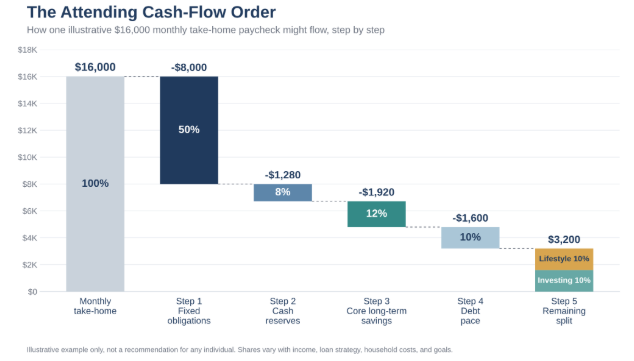
There isn’t one “right” answer. The goal is to know what you can afford to do and make those choices intentionally.
The right split looks different for different people. A physician working toward Public Service Loan Forgiveness (PSLF), a federal program that forgives the remaining balance on federal Direct Loans, tax-free, after 120 qualifying payments made under a qualifying repayment plan while working full-time for a government or 501(c)(3) nonprofit employer, will handle extra cash very differently from someone aggressively paying down refinanced loans. Someone saving for a house or supporting young kids may care more about keeping cash within reach.
You don’t have to choose between paying off your loans and investing. But you probably can’t do everything at full speed, either.
If you put every extra dollar toward your loans, you may be giving up years of investment growth. On the other hand, if you focus entirely on investing, you could still be making large loan payments well into your career. And if your lifestyle grows as quickly as your income, you may not have much left for either.
The math matters, but so does how you feel about the debt.
Maybe your loans have a relatively low interest rate, and you’d rather invest while making the required payments. Maybe the balance bothers you enough that you want to pay it off as quickly as possible. Both can be reasonable choices.
Your interest rates, investment goals, cash flow, and how you feel about the debt all matter. The goal is to build a plan that works on paper and feels right for you.
Decide How Aggressively to Pay Down Debt Without Pausing Wealth Building
Paying off debt and investing are rarely an either-or choice. Paying down debt gives you a known, certain benefit: less interest and fewer liabilities down the road. Investing early gives you something you can’t buy back later: years of potential compounding, where your earnings start earning returns of their own.
The right pace depends on the details: the type of debt and its interest rate, whether loan forgiveness is on the table, what your employer offers, your tax situation, and how much flexibility you need. So the first step is deciding what your debt strategy actually is. The second is figuring out how investing keeps moving alongside it.
Set the Debt Strategy Before Sending Extra Money to Loans
Before you pour extra money into loans, know what kind of debt you have and what you’re actually trying to accomplish. A big balance alone doesn’t tell you whether paying it down fast is the smartest next move for your cash.
Before deciding how much extra to send toward debt, weigh the factors that actually determine how aggressively it should be repaid:
Debt Type: Separate high-interest consumer debt, like credit cards, from student loans, mortgages, and other lower-cost debt. Different debts deserve different levels of urgency.
Student Loan Path: Decide whether PSLF, employer repayment help, refinancing, aggressive payoff, or some blend is your plan before you make large extra payments.
Interest Cost: Compare the interest you’d avoid by paying down principal, which is certain, against the return you might earn by investing, which is not. Avoid assuming the market will always beat your loan rate.
Payoff Timeline: Give your debt a defined plan and an end date, so it doesn’t just sit on your balance sheet for years simply because the monthly payment is easy to afford.
Career Flexibility: Think about whether changing employers, cutting clinical hours, or buying into a practice could change the math on your current loan strategy.
Peace of Mind: Sometimes the numbers favor investing, since your investments may earn more than your loan interest costs. But if the debt weighs on you and you’d sleep better without it, paying it down fast can be the right call anyway. That comfort is worth something you can’t put a number on, and we support that choice.
Pro-Tip: If you’re pursuing PSLF and have federal loans from before July 1, 2026, be cautious about consolidating or taking out any new federal loans now. A Direct Consolidation Loan completed on or after that date restricts all of your loans to RAP and the new standard plan, and it can affect your qualifying payment count. It’s worth confirming the impact with your servicer or advisor first.²
How Your Loan Path Often Shapes What Happens to Extra Cash (Illustrative)
| Loan Path | Often a Fit For | Where Extra Cash Often Goes | Key Watch-Out |
| PSLF | Physicians at government or 501(c)(3) nonprofit employers planning to stay 5–10 years | Investing and reserves, since extra loan payments may reduce the forgiven amount | Staying on a qualifying plan and certifying employment each year |
| Refinanced, aggressive payoff | Private practice or for-profit employment with higher-rate loans | A larger share toward loans, with employer match still captured | Refinancing federal loans ends access to PSLF and income-driven plans |
| Balanced payoff | Lower-rate loans and a preference for flexibility | A deliberate split between extra payments and investing | Letting the balance linger without a defined end date |
These are general patterns, not recommendations for any one person. Interest rates, employer type, and career plans can all change which path makes sense.
Keep Investing While Debt Is Still on the Balance Sheet
You usually don’t need to wait until your student loans are gone before you start investing. Starting early protects your compounding time and keeps debt repayment from delaying your retirement savings for years.
A few investing priorities can keep moving even while you’re still paying off debt:
- Put in enough to your workplace retirement plan to capture the full employer match when one is offered, since that match is essentially free money.
- Consider funding a Health Savings Account (HSA), a tax-advantaged account paired with certain high-deductible health plans, when you’re eligible, and the plan fits your medical and cash-flow needs.
- Look at additional workplace retirement contributions and Roth or backdoor Roth options (a legal way for high earners to get money into a Roth IRA even when their income is too high to contribute directly), based on your income, taxes, and benefits.
- Gradually increase your contributions as your income and spare cash flow grow, instead of assuming they have to stay small until every loan is paid.
- Add a regular taxable investment account (called a taxable brokerage account) when you want more flexibility and your reserves, debt plan, and core retirement saving are already in place.
Pro-Tip: If your employer is a hospital or health system, check whether it offers a 457(b) in addition to a 403(b). A governmental 457(b) can add significant tax-deferred space on top of your 403(b) limit, and withdrawals after separation from service generally aren’t subject to the 10% early withdrawal penalty.
Please note: The right balance between investing and paying off debt can shift a lot depending on your loan terms, forgiveness eligibility, employer benefits, tax situation, household needs, and available cash flow.
Let Your Lifestyle Improve Without Letting It Consume the New Paycheck
A common approach is to let lifestyle rise gradually and favor flexible spending over new fixed monthly commitments, especially in the first few years.
You earned this income, and part of the point is to enjoy it. The trick is letting your lifestyle rise without locking in costs that crowd out everything else you care about.
Housing: A gap exists between what a lender says you can afford and what actually leaves room for investing, debt payoff, family goals, and future career flexibility. Base the decision on the second number, not the first.
Vehicles and Financed Purchases: Adding big monthly payments soon after your income jumps can soak up cash that could have gone toward debt or wealth building. A financed car or two can lock you into years of payments before you’ve built any cushion.
Recurring Lifestyle Commitments: Frequent travel, memberships, household services, private school, and other regular upgrades can slowly set a much higher permanent spending baseline, one that’s hard to walk back later.
Flexible Spending: Leave yourself room to enjoy the money. Favor spending that can grow or shrink as your circumstances change, rather than treating every upgrade as permanent.
Major Lifestyle Upgrades: Tie big purchases to your overall financial direction, not just your salary. The question isn’t only whether you can make the payment. It’s whether the purchase leaves your debt plan, investing, and career flexibility intact.
Turn the Balance Into a Repeatable System
Automating the split between debt, investing, and spending can turn a monthly decision into a system, so progress doesn’t depend on what’s left at the end of the month.
You shouldn’t have to make a fresh debt-versus-investing-versus-lifestyle decision every single payday. Once you set your basic targets, automatic transfers and scheduled payments turn the balance into a system that runs on its own, instead of depending on whatever is left at the end of the month.
- Plan for extra income in advance: Deciding ahead of time how you’ll split raises, bonuses, signing incentives, and moonlighting income lets some of it improve your lifestyle while set portions go toward debt, investing, or other goals before the extra money slips into spending.
- Use milestones as resets: When a student loan or another large payment finally disappears, send at least part of that freed-up cash toward investing or another goal to keep the full amount from turning into permanent lifestyle spending.
- Check in periodically: A job change, marriage, kids, a home purchase, a debt payoff, or a big pay shift is a good reason to revisit the balance, rather than tinkering constantly.
Over time, progress tends to show up in three places: falling debt, growing investments and net worth, and more freedom over your future career choices.
How This Looks in Practice – A First-Year Attending Pursuing PSLF
Setting: Dr. Beesly, a 33-year-old family physician in her first year as an attending at a nonprofit health system, married with a toddler. This example is a composite for illustration.
Situation: Dr. Beesly’s household income had grown to $260K-$290K, and she was carrying about $240K in federal student loans. She had been on the SAVE plan during residency and hadn’t yet chosen a new plan after receiving her servicer’s notice. She and her spouse were also starting to look at homes, with a lender preapproval well above what they had expected.
What she did:
- Moved to a qualifying plan: Selected a PSLF-qualifying income-driven plan before her notice window closed and submitted an employment certification.
- Held off on extra loan payments: Since remaining balances were expected to be forgiven, directed extra cash to savings instead.
- Filled tax-advantaged space: Increased her 403(b) contributions and began contributing to the health system’s governmental 457(b).
- Built reserves before buying: Set aside six months of essential expenses before house-hunting in earnest.
- Set a housing payment ceiling: Chose a payment target based on the family’s full plan rather than the preapproval amount.
Result: Within the first year, Dr. Beesly kept her PSLF progress on track, built a full cash reserve, and bought a home with a payment that left room for her savings targets, while still leaving some room for lifestyle upgrades the family had delayed during training.
Physician Debt, Investing, and Lifestyle FAQs
1. What age do most doctors pay off their debt?
It varies widely, but many physicians pay off their student loans in their 30s or early 40s, depending on the balance, their repayment plan, and whether they pursue forgiveness. Aggressive payoff can shorten that, while forgiveness programs stretch it out on purpose in exchange for lower payments.
2. How much debt does an average doctor have?
Among medical school graduates who borrowed, the Class of 2025 owed an average of about $223,130, and roughly two-thirds of graduates carried education loans.1 Many also carry a mortgage and other debt, so the full picture is usually larger than the student loans alone.
3. Should physicians pay off student loans before investing?
Waiting until every loan is gone can cost you years of compounding. A common approach is to capture your full employer match and cover key priorities first, then balance extra debt payments and investing based on your interest rates and goals.
4. How much should a young physician invest while still paying off student loans?
You don’t necessarily have to choose between investing and paying down your loans. If you have access to an employer match, start there. From there, what makes sense depends on your loan interest rate, whether you’re pursuing forgiveness, and how much room you have in your monthly cash flow.
5. How much lifestyle spending is reasonable once you’re an attending?
There’s nothing wrong with enjoying the jump in income when you become an attending. The bigger concern is taking on too many new fixed expenses at once. Housing, cars, and other monthly commitments can add up quickly, so leave yourself enough room to keep making progress on your loans, investing, and other goals.
6. Should physicians use bonuses and extra income to pay debt or invest?
Many physicians split it. Bonuses, signing bonuses, moonlighting income, and other extra money can go toward a mix of debt, investing, and spending. The right balance depends on things like your loan interest rate, forgiveness strategy, and what else you’re working toward.
7. Should I refinance my student loans as a new attending?
It depends largely on whether you’re pursuing PSLF. Refinancing replaces federal loans with a private loan, which can lower your interest rate but permanently ends access to PSLF and income-driven repayment plans. For physicians in private practice or for-profit employment with higher-rate loans, refinancing may make sense, while those at qualifying nonprofit or government employers often keep their federal loans.
Get Help Balancing Debt, Investing, and Lifestyle Across Your Medical Career
Early in your career, a lot is competing for your paycheck. You may be paying down student loans, trying to invest, and still want to enjoy the higher income that comes with becoming a physician. You don’t have to put everything else on hold to make progress.
At WealthKeel, we help physicians look at the whole picture, including student loans, cash flow, investing, and the lifestyle choices that come with a higher income. That might mean figuring out how much to put toward loans versus retirement, or deciding whether a bigger house or other major expense fits comfortably into your plan.
That balance should shift as your compensation, debt, family, benefits, assets, and goals change, which is why it helps to revisit it throughout your career rather than set it once and forget it. If you’d like a clear read on where you stand and where you’re headed, schedule a free Icebreaker Call with our team.
Resources
- Education Data Initiative, Average Medical School Debt (data from the Association of American Medical Colleges)
- Federal Student Aid (StudentAid.gov): 2026 Repayment Plan Changes
Disclosures: WealthKeel Disclosures