Key Takeaways
- The attending transition works best with a defined cash-flow system. Benefits, loan direction, reserves, protection, and automatic contributions generally need a plan before recurring expenses absorb the raise.
- Mid-career wealth benefits from clearly defined account roles. Taxable, pre-tax, Roth, cash, education, and practice assets can each support different timelines while preserving career flexibility.
- Retirement preparation generally starts well before withdrawals begin. About a decade out, connecting spending, outside income, healthcare, and taxes into one projection can clarify the path toward the exit from medicine.
https://www.youtube.com/watch?v=MxH3xPVFXvE&feature=youtu.be
Physicians often reach peak earnings later than other professionals. Medical school, residency, and fellowship can delay compensation, while student loans, housing decisions, and family needs tend to arrive close together once training ends.
A financial plan generally needs to change as pay, benefits, assets, responsibilities, and retirement goals develop over a career. Rather than one lifelong checklist, the right priorities tend to shift with each stage — from building a foundation, to coordinating a growing balance sheet, to preparing an exit.
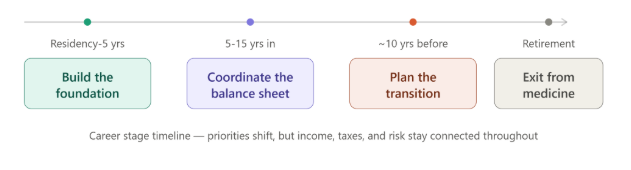
Residency Through the First Five Attending Years: Build the Foundation
The first attending years are best spent turning new income into a defined system — benefits, loan direction, reserves, and protection — before lifestyle and recurring costs absorb the raise.
This stage runs from late medical training through roughly the first five attending years, when higher pay often arrives alongside taxes, relocation, benefits, housing, and family needs. The early objective is turning new income into a stable system before recurring costs absorb the difference, which can create room for investing, family priorities, and future career flexibility.
Before and During the Attending Transition: Clarify the New Financial System
The attending transition changes both the paycheck and the decisions competing for it. A few areas tend to deserve early attention:
- Compensation and Benefits: Base pay, bonuses, RVUs, relocation help, employer loan repayment, vesting schedules, and health plan options can shape an offer well beyond the headline salary.
- Take-Home Cash Flow: A budget built around net pay, after withholding, deductions, and premiums, tends to hold up better than one based on gross salary.
- Student Loan Direction: Public service loan forgiveness, refinancing, and blended repayment options each fit different situations. PSLF generally requires eligible Direct Loans, qualifying employment, an eligible repayment plan, and 120 qualifying payments.¹
- Initial Cash Reserves: An emergency fund, kept in a separate savings account, can help absorb moving costs, benefit gaps, and uneven early paychecks.
Pro-Tip: PSLF tracks qualifying payments, not just payments made — so a payment made under the wrong plan or on the wrong loan type generally does not count toward the 120 needed.¹ It helps to confirm loan type and repayment plan eligibility before the first attending paycheck arrives, not after several years of payments.
During the First Five Attending Years: Protect Income and Build Momentum
Once the job and monthly system are clearer, new dollars can start addressing the risks and goals shaping the next decade:
- Disability Coverage: Own-occupation disability insurance, monthly benefit amounts, and elimination periods are worth comparing against any employer coverage already in place.
- Core Protection and Legal Documents: Term life insurance, malpractice coverage, a will, and healthcare directives tend to matter more once others depend on your income.
- Investing Order: A flexible order often includes the employer match, a health savings account, and workplace or taxable accounts. Qualified HSA withdrawals can be tax-free,² while pre-tax IRA balances matter for backdoor Roth conversion reporting.³
- Housing and Lifestyle Commitments: A home purchase, physician mortgage, or other recurring commitment generally holds up better when weighed against job stability and savings momentum.
The goal at this stage is not simply to save more. The goal is to build a system — income, protection, and investing working together — that can absorb a promotion, a partnership offer, or a growing family without starting from scratch.
Roughly Five to Fifteen Years Into Practice: Coordinate the Growing Balance Sheet
Mid-career planning is less about accumulating new accounts and more about giving each existing account, and each dollar of protection, a clearly defined role.
By this stage, many physicians have made progress on loans, built larger accounts and home equity, and taken on more family responsibilities. The focus tends to shift from getting started to coordinating what’s already been built, since a growing balance sheet can create more control over taxes, family choices, and eventual career changes.
Give Every Account and Tax Decision a Clear Role
Mid-career accounts often accumulate one at a time, and reviewing them together can clarify what’s accessible, restricted, or available before retirement:
- Full Account Inventory: A 401(k), 403(b), 457(b), Roth, brokerage, HSA, and any practice assets can each serve a different purpose and time horizon.
- Pre-Tax and Roth Balance: Comparing today’s marginal rate against projected future income can help clarify how much flexibility pre-tax versus Roth balances offer later.
- Taxable Investment Management: Rebalancing, loss harvesting, and asset location tend to matter more as investing outside workplace plans grows.
- Household Coordination: Reviewing both spouses’ benefits and career timelines as one system can surface gaps that are easy to miss account by account.
The table below illustrates how these account types tend to differ once income, taxes, and access rules are considered together.
| Account Type | Tax Treatment | Typical Mid-Career Role | Access Before 59½ |
| Employer Retirement Plan (401(k)/403(b)) | Pre-tax or Roth contributions | Core long-term growth, often with a match | Generally limited, exceptions apply |
| HSA | Pre-tax in, tax-free out for qualified expenses² | Medical costs now or a stealth retirement account later | Penalty-free for qualified medical expenses |
| Taxable Brokerage | After-tax dollars, capital gains rates | Flexibility, mid-term goals, early retirement bridge | Generally unrestricted |
| Roth IRA/Backdoor Roth | After-tax in, tax-free growth | Long-horizon tax diversification³ | Contributions generally accessible; earnings restricted |
| 457(b) (Governmental or Nongovernmental) | Pre-tax, employer-specific rules | Supplemental deferred compensation | Varies significantly by plan⁵ |
| Practice/Partnership Interest | Varies by structure | Ownership stake, eventual buyout or sale proceeds | Generally illiquid until a triggering event |
Please Note: Tax planning strategies at this stage generally span several years, since today’s account mix can affect future conversions, gains, and required distributions.
Keep Protection, Family Costs, and Lifestyle Growth in Balance
A larger balance sheet changes both what needs protection and how much lifestyle it can reasonably carry. Umbrella, home, auto, and life insurance coverage may be worth another look as property, vehicles, or business interests expand, and titling on real estate or practice interests can raise state-specific asset protection questions that benefit from legal guidance.
Estate planning documents, including wills, healthcare directives, and beneficiary forms, tend to need updates as family and assets change. Setting boundaries around childcare, school, travel, and other family costs can help keep them from crowding out retirement savings, particularly for practice owners already carrying business obligations alongside personal goals.
How This Looks in Practice – A Mid-Career Practice Owner
Dr. Beesly, a 47-year-old physician partner in a private practice, roughly twelve years into her career.
Situation: Dr. Beesly had accumulated a 401(k), an HSA, a taxable brokerage account, and an equity stake in her practice, but had never reviewed them as one system. Umbrella coverage had not been updated since her home purchase eight years earlier, and her estate documents predated the birth of her second child.
- Consolidated old retirement accounts and mapped each account, including her practice interest, against a specific future use.
- Increased umbrella liability coverage to reflect her current home equity and practice ownership.
- Updated her will, healthcare directive, and beneficiary designations to reflect her current family and asset picture.
- Coordinated her contribution strategy with her spouse’s employer benefits to avoid duplicating coverage and missing available matches.
Result: Dr. Beesly entered her next partnership review with a clear picture of which accounts were doing which job, updated protection matched to her actual balance sheet, and estate documents that reflected her current family — rather than reacting to a buyout offer or a life event without a plan already in place.
About Ten Years Before Retirement: Shift From Accumulation to Transition Planning
Roughly a decade before a target retirement date, the priority shifts from growing the portfolio to preparing specific buckets of money and specific tax windows for the withdrawal phase.
The final working decade often includes strong earnings, while retirement becomes a practical decision about spending, withdrawals, taxes, and healthcare rather than a distant idea. Retirement planning at this point generally benefits from a specific timeline rather than a general sense of someday.
Define the Retirement Income Gap
An after-tax spending estimate built around the life you want, including housing, travel, family support, and irregular costs, can serve as a starting point. Comparing that figure against income sources outside the portfolio, such as Social Security, deferred compensation, or practice-sale payments, can help define the gap the portfolio actually needs to cover, and testing that gap against different retirement dates and healthcare costs can show whether the current path holds up.
The Bucket Approach to Pre-Retirement Withdrawals
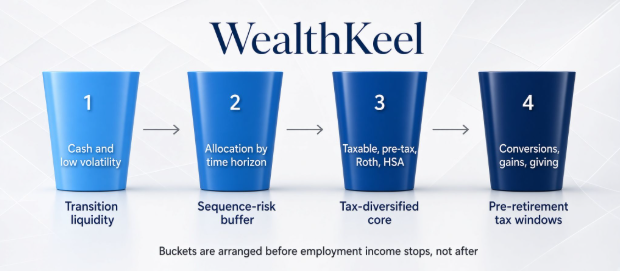
A withdrawal plan generally works best when it separates money by both time horizon and tax treatment, arranged before employment income stops. A simple, ordered way to think about it:
- Bucket One — Transition Liquidity: Cash and lower-volatility holdings sized to cover early retirement spending without forcing sales during a weak market.
- Bucket Two — Sequence-Risk Buffer: Allocation reassessed based on when dollars are likely to be spent, since near-term withdrawals generally call for more stability than later ones.
- Bucket Three — Tax-Diversified Core: Taxable, pre-tax, Roth, and HSA assets coordinated so withdrawals and rebalancing support the broader tax picture rather than one account at a time.
- Bucket Four — Pre-Retirement Tax Windows: Roth conversions, gains, and charitable giving considered once earned income falls, before required distributions begin.
Pro-Tip: Household income from two years before Medicare enrollment can determine Part B and Part D premiums through IRMAA.⁶ A large Roth conversion or practice-sale gain in the wrong year can unintentionally raise premiums two years later, so it deserves a look alongside the rest of the pre-retirement tax plan, not in isolation.
Coordinate Healthcare and the Exit From Medicine
For physicians who may stop working before age 65, pricing the gap between employer coverage and Medicare is worth doing early, since retirees who lose job-based coverage can generally use the Marketplace until Medicare begins.⁴ Governmental and nongovernmental 457(b) plans, deferred compensation, and any partnership or sale terms also deserve a plan-specific review before a separation date is set, since distribution restrictions and tax timing can vary.⁵
The shape of the exit itself, whether full retirement, reduced hours, or consulting, affects the projection too. Household income in the years just before Medicare can affect Part B and Part D premiums through IRMAA, which is worth factoring into the plan alongside everything else.⁶
Use Milestones, Not Ages Alone, to Revisit the Plan
Career ranges are useful guideposts, but fellowship length, specialty, employer type, and family timing can move decisions earlier or later than the general timeline suggests. A new attending role, compensation change, partnership opportunity, or other significant shift in work tends to be a natural point for a focused review.
Marriage, divorce, children, a home purchase, or an inheritance can also shift the timeline, and revisiting the plan while those choices are still adjustable tends to work better than waiting. Reduced hours, a practice sale, or a new target retirement date generally calls for a fresh projection, and a periodic review can help catch gradual drift in taxes, balances, and priorities before it compounds.
Financial Planning Timeline for Physicians FAQs
1. When should physicians begin working on a financial plan?
Starting during training, even with a simple system for spending, reserves, and protection, tends to give the first attending paycheck more structure from the outset.
2. What should a physician prioritize after becoming an attending?
Net pay, benefit elections, the loan path, and reserves generally come first. Contributions and larger housing or lifestyle decisions tend to work better once those pieces are already in motion.
3. Should a new attending physician pay off student loans or invest first?
The answer depends on loan type, rates, forgiveness eligibility, and household goals. Many physicians use a blended approach that captures the employer match while still making scheduled or accelerated loan payments.
4. Does the financial planning timeline differ for employed, academic, private-practice, and 1099 physicians?
Generally, yes, since benefits, taxes, forgiveness eligibility, and business responsibilities vary by employment structure.
5. When should physicians shift from accumulating wealth to planning retirement withdrawals?
Detailed transition work about a decade before the preferred retirement date tends to leave enough time to estimate spending, organize account roles, and coordinate healthcare.
6. How often should a physician update a financial plan?
A periodic review, along with a check-in after major career, family, or health changes, tends to keep the plan aligned as circumstances evolve.
Build a Financial Plan That Keeps Pace With Your Medical Career
Physician planning tends to be a progression rather than a single decision. Choices made during training and the first attending years can create the structure that supports coordination, flexibility, and retirement choices later on.
At WealthKeel, we help physicians organize compensation, benefits, protection, investments, taxes, and estate planning around their current career stage, connecting each decision to the next rather than treating topics in isolation.
You do not need a complete plan or all the answers before reaching out. As your work, earnings, family responsibilities, or retirement timing change, we can revisit the plan with you. If you’re ready to talk through where you are now, we invite you to schedule a free Icebreaker Call with our team.
Resources: