
Key Takeaways:
- Your first attending years are about setting things up. Build around your actual take-home pay, a clear plan for your loans, income protection, and automatic saving, before your spending creeps up to match the bigger paycheck.
- The middle years are about coordination. Your accounts, taxes, investments, insurance, and family spending should all work together, so your money buys you more freedom in your career.
- The final working years are about switching gears. You turn everything you saved into a plan that pays you a steady income once you stop working, covering spending, taxes, healthcare, and how you leave practice.
https://www.youtube.com/watch?v=c4p-tM1kGVk
Doctors hit their big earning years later than almost everyone else. Between four years of medical school and three to seven years of residency, most spend close to a decade training after college before they earn a full paycheck, often reaching it in their early-to-mid 30s.1 Meanwhile, student loans, buying a home, and starting a family all tend to pile up around the same time.
So your financial checklist can’t stay the same forever, it has to grow with you. What matters most in your first attending job is different from what matters at mid-career or in your last decade of work. Here’s what to focus on at each stage.
Early-Career Physicians: Build the Foundation
This stage runs from training through roughly your first five years as an attending. The bigger paycheck finally gives you some breathing room, but taxes, benefits, loans, housing, and lifestyle all start competing for it fast.
The goal here is to build a solid base before permanent expenses grow up around your paycheck. Planning early gives every dollar a job and keeps your future options open.
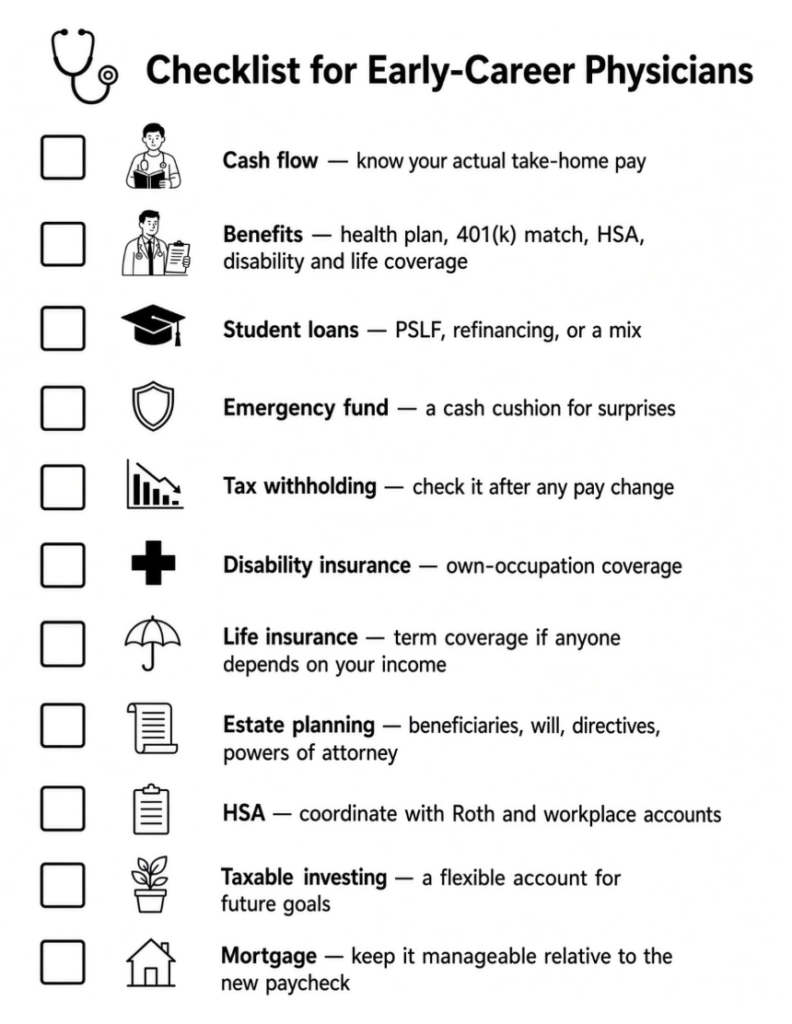
Get Your Cash Flow, Benefits, and Loans Organized
Your first checklist is about seeing clearly: what actually lands in your account, what your employer gives you, and what your debt demands. Start with the things that decide how much freedom your paycheck gives you:
- Cash flow: Figure out your actual take-home pay, what’s left after taxes, benefits, insurance, and retirement contributions. Try not to let bonus or extra-shift pay turn into money you count on for your regular bills.
- Benefits: Look at your work health plan, any 401(k) match and vesting (how long until the employer’s contributions are fully yours), whether you can use an HSA, and any disability or life insurance your job includes.
- Student loans: Compare your options: public service loan forgiveness (PSLF), refinancing, paying it off fast, or a mix. PSLF can wipe out your remaining federal Direct Loan balance after 120 qualifying monthly payments while you work full-time for a qualifying employer, usually a nonprofit or government job.2
- Emergency fund: Keep a cash cushion for the surprises: credentialing delays, moving costs, a gap between jobs, or just life.
- Tax withholding: After a signing bonus, a job change, or a big change in your spouse’s income, double-check how much tax is coming out of your paycheck so you’re not caught off guard at tax time.
Protect Your Income and Put Saving on Autopilot
Once your loans and monthly budget have some structure, protect the thing the whole plan runs on: your ability to earn. These steps guard your paycheck while building flexibility:
- Disability insurance: This pays you if you get hurt or sick and can’t work, and for doctors it’s a big deal. Look for “own-occupation” coverage, which pays out if you can’t do your specific specialty, even if you could technically do some other job.
- Life insurance: If anyone depends on your income, get term life insurance (simple, affordable coverage for a set number of years). Check your malpractice and personal liability coverage too, as you build up more to protect.
- Estate planning: Set your beneficiaries, a will if you need one, healthcare directives, and powers of attorney (people you name to make money or medical calls if you can’t). Add guardianship for your kids if you have them.
- Health savings account (HSA): If you’re eligible, an HSA lets you save for medical costs tax-free. Coordinate it with your Roth and workplace accounts. Money you take out for qualified medical costs generally isn’t taxed.3
- Taxable investing: Once the basics are running, add a regular investment account (no special tax perks, but you can pull the money out anytime) for goals like a house, kids, or a future career change.
- Mortgage: Keep your house and other big recurring bills manageable after the new paycheck settles in. Staying flexible now makes everything easier later.
Mid-Career Physicians: Coordinate What You’ve Built
After roughly five to fifteen years in practice, you’ve probably got a bunch of moving pieces: workplace accounts, Roth money, home equity, college savings, and regular investments. Family spending usually picks up around now too.
The job shifts from building to coordinating: getting all those pieces working together for lower taxes, better protection, and more say over how and when you work.
Coordinate Your Accounts, Taxes, and Investments
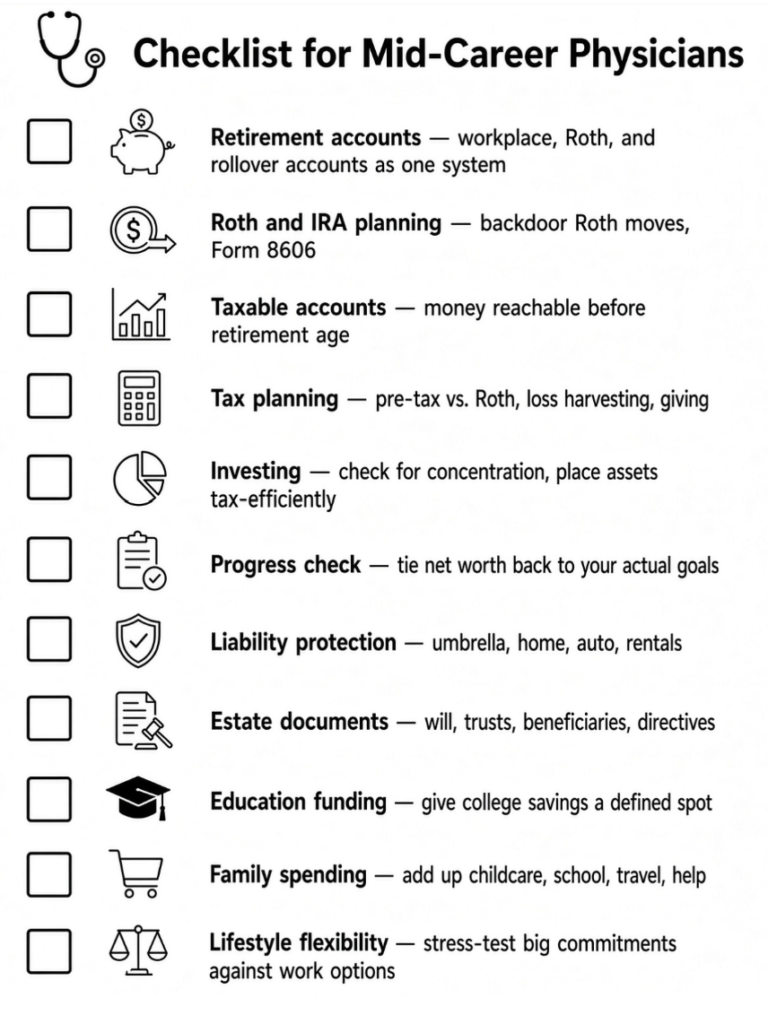
Mid-career money is really about how the pieces fit together. How your accounts are taxed and when you can get at them can decide whether cutting back your hours, or reaching financial independence early, is actually doable. Look at your whole balance sheet as one system:
- Retirement accounts: Look at your workplace, Roth, and rollover accounts together: how they’re taxed, when you can touch them, and whether they’re building the flexibility you want.
- Roth and IRA planning: Review your backdoor Roth moves (a way for high earners to get money into a Roth even over the income limit) and keep your paperwork straight, especially IRS Form 8606, which tracks that after-tax money and any conversions.4
- Taxable accounts: Keep building money you can actually reach before retirement age, for a career change, a big family goal, or early financial independence.
- Tax planning: In your high-income years, weigh pre-tax versus Roth contributions, harvesting investment losses to offset gains, and charitable giving, thinking about both this year’s taxes and your future.
- Investing: Check whether too much of your money is riding on one thing: your employer’s stock, one fund, or a single property. And put each investment in the account where it’s taxed best.
- Progress check: Tie your spending, savings rate, and net worth back to what you actually want. For a lot of high earners, progress means finally having the option to work less.
Scale Up Protection and Keep Family Spending in Check
As your assets and family responsibilities grow, so does what’s at stake. Your insurance, college savings, and everyday spending all need to protect your flexibility rather than eat into it. Look at where bigger responsibilities can shrink your options:
- Liability protection: Revisit your umbrella insurance (extra coverage on top of your home and auto, in case you’re sued for more than they cover), your home and auto limits, and any rental properties or side work, plus teenage drivers as they come.
- Estate documents: Update your will, any trusts, beneficiaries, healthcare directives, and how things are owned after a big family, asset, or move change.
- Education funding: Give college savings a defined spot in the plan so it doesn’t just soak up whatever extra cash shows up.
- Family spending: Add up childcare, school, travel, household help, and money you give to relatives. Seeing the actual total makes the tradeoffs way clearer.
- Lifestyle flexibility: Before you commit to a bigger house, a renovation, or a practice buy-in, stress-test it against your future work options. Plenty of doctors can afford these things, but “can afford it” and “keeps me flexible” aren’t the same thing.
Established-Career Physicians: Get Your Wealth Ready for Life After Full-Time Work
Well into your career, usually in your last decade of full-time work, the question changes to what everything you’ve saved can actually pay for. Whether you’re ready depends on your spending, taxes, healthcare, how your money’s invested, and your timing.
You’ve still got time to make smart moves while you’re earning. The work now is turning your savings into a solid, practical plan for after you stop.
Turn Your Savings Into a Retirement Income Plan
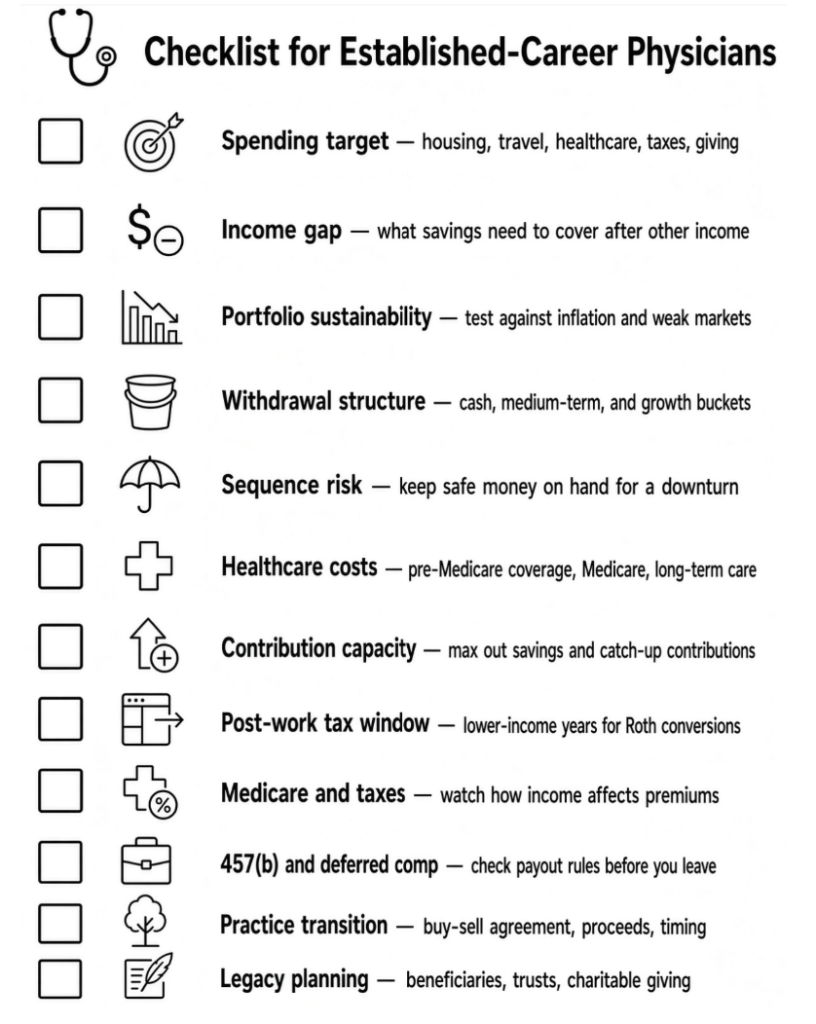
A good retirement income plan starts with the life you want to fund, then works backward to figure out where the money comes from. Use these checks to test the switch from working to living off your savings:
- Spending target: Add up housing, travel, family support, healthcare, taxes, giving, and the irregular stuff, so your number reflects your actual life.
- Income gap: Subtract your steady income, Social Security, a pension, deferred pay, practice-sale money, rental income, from what you plan to spend. What’s left is the job your savings have to do.
- Portfolio sustainability: Test whether your money lasts against inflation, a long life, and weak markets, instead of trusting one big account balance to tell the whole story.
- Withdrawal structure: Sort your money into buckets: cash for soon, steadier stuff for the medium term, and growth for the long haul, so you know where each year’s spending comes from.
- Sequence risk: This is the danger of a market crash right as you start withdrawing. Selling investments while they’re down, to cover living costs, does lasting damage, so keep enough safe money on hand to avoid it.
- Healthcare costs: Budget for coverage before Medicare if you retire early, then Medicare costs, out-of-pocket care, and possible long-term care.
Use Your Final Working Years to Handle Taxes, Your Exit, and Your Legacy
The years right around leaving practice can open up tax opportunities, before a bunch of income sources start overlapping. Use this window to line up decisions before the paycheck stops:
- Contribution capacity: Max out your workplace savings, catch-up contributions (extra amounts allowed once you’re 50 or older), HSA, and Roth moves during these high-earning years. Note that as of 2026, IRS rules require catch-up contributions to be made on a Roth basis if your prior-year wages were above roughly $150,000, which covers most attending.5
- Post-work tax window: Spot the lower-income years after you stop working but before other income kicks in. Those can be great for Roth conversions or planned withdrawals at a lower tax rate.
- Medicare and taxes: Big conversions, investment gains, or deferred pay can bump up your Medicare Part B and Part D premiums, which are based on your income from two years earlier.6
- 457(b) and deferred comp: If you have a non-governmental 457(b) plan, check the payout rules before you leave. That money technically still belongs to your employer and could be at risk if the company runs into trouble, so the details matter.7
- Practice transition: If you own part of a practice, review your buy-sell agreement, the proceeds, and the payout timing. Your next chapter might be fewer hours, consulting, teaching, or full retirement.
- Legacy planning: Line up your beneficiaries, any trusts, charitable giving, and how things are owned with what you’ve got and what your family needs.
Please Note: These career-stage ranges are rough guideposts rather than hard rules. Owning a practice, a big windfall, an inheritance, a health change, or hitting financial independence early can move you into a later stage sooner than the years suggest.
Financial Checklist for Physicians by Career Stage FAQs
1. What should new attendings focus on financially?
Start with your take-home pay, a clear plan for your loans, some cash savings, your benefits, income protection, and automatic saving. That gives your paycheck structure before your lifestyle costs lock in.
2. How does the checklist change in mid-career?
It shifts toward coordination. Your accounts, taxes, family costs, insurance, and investments should all work together to give you more control over your future choices.
3. When should I start serious retirement planning?
Before it’s staring you in the face. Within about ten years of leaving full-time work, your spending, healthcare, withdrawals, taxes, and exit timing deserve a detailed look.
4. Should high-income physicians choose pre-tax or Roth contributions?
It depends on your current tax rate, your expected future income, your balances, and how much tax flexibility you want. Using both gives you more options when it’s time to withdraw.
5. How often should I review my insurance and estate documents?
After any big change: marriage, kids, a move, a home purchase, buying into a practice, or a jump in your net worth. A regular check also catches outdated beneficiaries or coverage gaps.
6. What changes should trigger a full plan review?
A new job, a big pay change, paying off your loans, marriage, kids, a move, practice ownership, an inheritance, cutting back your hours, or nearing retirement, any of these is a good reason to look at the whole picture.
Build a Money Plan That Keeps Pace With Your Career
Your money priorities should shift over time, from building a base, to coordinating what you’ve built, to getting it ready for life after full-time work. Moving through those stages on purpose keeps your decisions tied to the life you actually want.
Our team can help you figure out what matters now, what can wait, and how your benefits, taxes, investments, insurance, and family goals all fit together. If you’d like a hand with any of it, schedule a free Icebreaker Call with our team.
Resources:
1) AAMC: What’s the Journey to Residency Like?
2) Federal Student Aid: Public Service Loan Forgiveness
3) IRS Publication 969: Health Savings Accounts
4) IRS Instructions for Form 8606
5) IRS: Retirement Topics – Catch-Up Contributions
6) Medicare: Income-Related Monthly Adjustment Amounts
7) IRS: Non-Governmental 457(b) Deferred Compensation Plans
Disclosures: WealthKeel Disclosures