
Key Takeaways:
- Net worth is a clearer measure of progress than income: A high salary can create the feeling of wealth without building much of it. Net worth tracks what you keep and grow, which often determines how many choices you have later.
- The right target generally shifts with your career stage: In training and the first few attending years, getting to positive is often the win. Mid-career, many physicians aim for seven figures, and later the focus typically moves to becoming work-optional.
- A late start does not have to mean falling behind: Years of training and debt mean most physicians start behind their non-medical peers, but a physician income used intentionally can often build substantial wealth over 15–25 years.
Most physicians eventually become millionaires. About 6 in 10 physicians reported a family net worth of $1 million or more in Medscape’s 2024 Physician Wealth & Debt Report.¹ That also means roughly 4 in 10 had not, many of them after years of strong W-2 income, call pay, or partnership distributions. The difference often has less to do with how much you earn and more to do with how that income is directed over time.
That’s why net worth goals tend to work best when they match your career stage. “On track” looks very different for a PGY-3 carrying $250K-$400K in loans than for a partner 20 years into practice. At every stage, your net worth is shaped by several parts of your plan at once: income, taxes, debt, and risk protection.
Below, we walk through what a healthy net worth may look like at each stage, what tends to move it most, and how to tell whether you’re on pace.
youtube.com/watch?v=ECcBKT77QRE&feature=youtu.be
What Net Worth Means for Physicians
Net worth is what you own minus what you owe. Add up your assets (cash, retirement accounts, taxable investments, home equity, and any practice equity), then subtract your liabilities (student loans, mortgage, auto loans, practice buy-in notes, and credit card balances). The result is your net worth.
For physicians, this number often tells a truer story than salary. A $400K income can coexist with a net worth that barely moves if loan payments, a large mortgage, and lifestyle growth absorb most of each paycheck.
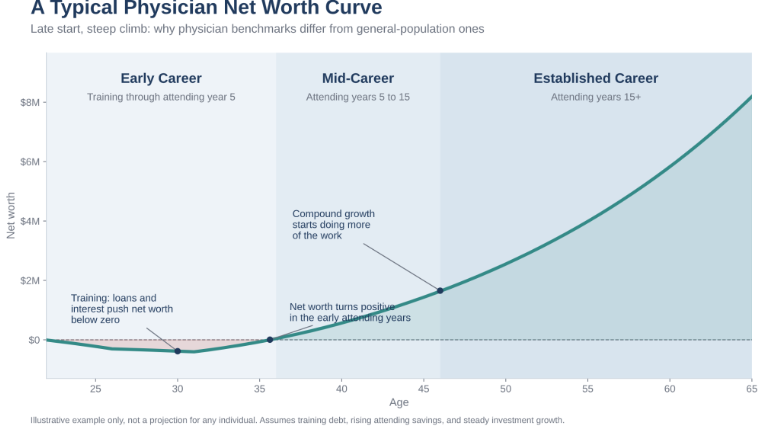
Physicians also follow an unusual financial path. You may spend 7–15 years in medical school, residency, and fellowship earning relatively little while loans accrue interest, so many doctors begin attending life with a negative net worth. Income then tends to rise sharply, often 3–5x a resident salary, within a year or two. That delayed, steep curve is why physician benchmarks rarely match general-population ones.
Pro-Tip: When you list practice equity or a pending partnership buy-in, it may help to record it at a conservative value, or leave it out, until the buy-in is complete and the buyout terms are clear. Practice equity is often illiquid, and its value on paper can differ significantly from what you’d actually receive at exit.
The goal is not to judge where you are today. It’s to understand the shape of the curve you’re on.
Net Worth Goals for Physicians by Career Stage
Most doctors end up wealthy. According to the Medscape Physician Wealth & Debt Report, nearly 6 in 10 physicians (about 59%) have a net worth over $1 million.1 But that also means a good share don’t, even after decades of strong paychecks. The difference usually comes down to how well someone manages money over a career, rather than how much they earn.
That’s why it helps to have net worth goals that fit where you are in your career. What counts as “on track” looks very different for a resident buried in student loans than for a physician 20 years into practice. Let’s walk through what a healthy net worth looks like at each stage, and how to tell if you’re on pace.
What Net Worth Means for Physicians
Net worth is simple: what you own minus what you owe. Add up your assets (your savings, investments, home, and anything else of value), then subtract your liabilities (your debts, like student loans, a mortgage, or credit cards). The number left over is your net worth.
For doctors, this number tells a truer story than your salary. It’s easy to earn a lot and still struggle to build wealth, especially if debt and spending eat up your income.
Physicians also have an unusual financial path. You spend years in school and training earning little while debt piles up, so many doctors start their careers with a negative net worth. Then income jumps sharply once you’re an attending (a fully trained, practicing doctor). That late start is why physician net worth goals look different from most people’s.
A healthy net worth goal generally depends on how long you’ve been in practice, not on your age. Because physicians start late and then earn at a high level, progress tends to move through three broad phases.
Early Career: Moving From Negative to Positive and Growing
In residency, fellowship, and roughly the first 1–5 attending years, a negative net worth is common, and it isn’t a sign that something has gone wrong. Between medical school loans and several years of training pay, many physicians are $200K-$500K+ below zero at this stage.
The priority here usually isn’t a big number. It’s momentum. That may include:
- Emergency reserve: Building 3–6 months of expenses in cash, ideally before or shortly after your first attending job starts.
- Loan strategy: Choosing a student loan path, such as Public Service Loan Forgiveness (PSLF), refinancing, or aggressive payoff, that fits your employer type and career plans.
- Early investing: Contributing to your 401(k) or 403(b), at least enough to capture any employer match, even while loans remain.
- Core protection: Putting own-occupation disability insurance in place, since your future earning power is likely your largest asset at this stage.
Getting to zero, then positive, and pointed upward is often the real win here.
Mid-Career: Turning a High Income Into Seven-Figure Wealth
Roughly 5–15 years into attending life, income is often at or near its peak, and training debt is shrinking or gone. This is the stage where net worth can grow quickly, provided a meaningful share of income flows to savings rather than to a lifestyle that expands with each raise.
Many physicians at this stage aim to cross $1 million in net worth and keep climbing. Compound growth, your investments earning returns on prior returns, typically becomes a larger driver of progress here. Decisions about savings rate, tax-advantaged accounts, partnership buy-ins, and home purchases may do more for your long-term net worth during these years than at almost any other point in your career.
Established Career: Building Toward Work-Optional
At 15+ years, the question often shifts from how to grow your wealth to whether it’s enough. The focus is typically financial independence: having enough invested that work becomes a choice rather than a requirement. That matters whether you plan to retire fully, go part-time, drop call, or move to locums.
A common reference point is roughly 25x your annual spending in investable assets (your investments, not counting your home). For a household spending $150K-300K per year, that points to roughly $3.75M-$7.5M. This rule of thumb is a starting point rather than a guarantee, since taxes, Social Security timing, healthcare costs before Medicare, and market returns can all shift the real number.
Illustrative Physician Net Worth Ranges by Career Stage:
| Career Stage | Typical Timeframe | Illustrative Net Worth Range | Primary Focus |
| Training and early attending | Residency through attending years 1–5 | -$500K to $250K | Stabilize debt, build reserves, start investing |
| Mid-career | Attending years 5–15 | $500K to $3M | Protect savings rate, grow investable assets |
| Established career | Attending years 15+ | $2M to $8M+ | Reach work-optional, plan the transition |
These ranges are general illustrations, not targets for any one person. Specialty, geography, household income, family size, and loan strategy can place two physicians of the same age in very different, and equally healthy, positions.
That does not mean a benchmark is useless. It means the direction of travel matters more than any single number.
What Moves a Physician’s Net Worth the Most
Savings rate, tax efficiency, and debt strategy often matter more than income level. Two physicians earning similar incomes can end up millions apart, typically because of a handful of recurring decisions.
- Savings rate: Saving 20%–30% of gross income is a common range for physicians who start later, though the right figure depends on when you finished training and what you want work to look like later.
- Tax efficiency: Using 401(k), 403(b), 457(b), HSA, and backdoor Roth contributions (a way for high earners to fund a Roth IRA indirectly) can meaningfully increase how much of each dollar stays invested. For practice owners, retirement plan design and entity structure may matter as well.
- Debt strategy: Every dollar of principal paid down raises net worth by a dollar, so the interest rate and forgiveness eligibility of each loan are worth understanding well.
- Practice ownership: A partnership can raise both income and net worth, but buy-in costs, K-1 income, and buyout terms deserve a close look before counting that equity as wealth.
- Risk protection: Disability insurance, malpractice coverage (including tail coverage when changing jobs), and umbrella liability coverage don’t raise net worth directly, but they help protect what you’ve built from a single event.
In Medscape’s 2026 report, around 1 in 5 physicians reported a family net worth of $5 million or more, a share that has grown notably since 2023.² Those households rarely got there on income alone.
Net worth tends to grow fastest when these pieces work together rather than on separate tracks.
How to Tell Whether Your Net Worth Is On Track
The simplest check is whether your net worth is higher than it was a year ago, and whether the increase roughly matches what you saved. Career stage is a rough guide, but a repeatable annual check tells you more about your own trajectory.
The Annual Net Worth Check-In Framework
- Pick a consistent date: Tally everything on the same date each year (many physicians use January 1 or their contract anniversary) so comparisons stay clean.
- List assets in two groups: Separate investable assets (retirement accounts, brokerage accounts, cash reserves) from lifestyle assets (home equity, vehicles). Investable net worth is often the better measure of progress toward work-optional.
- List every liability: Include student loans at their current balance with any capitalized interest, the mortgage, auto loans, and any practice buy-in note.
- Calculate the year-over-year change: Compare this year’s total to last year’s in both dollars and percentage.
- Compare the change to what you saved: If net worth grew by less than your contributions and debt paydown combined, market moves or lifestyle spending may be absorbing more than expected. That’s worth reviewing.
Pro-Tip: If you’re pursuing PSLF, it can help to track two versions of net worth: one with the full loan balance and one excluding the portion you reasonably expect to be forgiven after 120 qualifying payments. The first is more conservative, and the second may better reflect your actual trajectory.
It’s natural to compare yourself with colleagues, but their loans, specialty, household income, and plans rarely match yours. A more useful reality check: even in Medscape’s 2026 report, roughly 1 in 3 physicians reported a net worth under $1 million,² often because a high income masked a low savings rate. The purpose of tracking is to catch that pattern early.
Steady upward movement usually means more than hitting a specific figure.
How This Looks in Practice – A Partner-Track Anesthesiologist Seven Years Out
Setting: Dr. Michael Scott, anesthesiologist, age 38, seven years into practice at a physician-owned group, married with two children.
Dr. Scott’s household income had grown to $550K-$650K, including partnership distributions reported on a K-1. On paper, net worth was roughly $1.3M, which felt on track. But about half of that was home equity and practice equity tied to a recent buy-in, and growth in investable assets had slowed even as income rose.
What they did:
- Separated investable and lifestyle assets: This showed investable net worth closer to $600K-$650K, which reframed the conversation.
- Set an automatic savings target: Directed about 25% of gross income to savings through payroll deferrals and transfers timed to quarterly distributions.
- Filled tax-advantaged space: Maxed the group 401(k) and profit-sharing contributions, added backdoor Roth IRAs for both spouses, and began evaluating a cash balance plan (a type of pension that can allow much larger pre-tax contributions) with the group.
- Reviewed protection: Updated own-occupation disability coverage to reflect the higher income and added a $3M umbrella policy.
- Clarified buy-in terms: Documented the buyout formula so practice equity could be valued conservatively.
Result: Over three years, investable net worth grew from roughly $625K to about $1.25M, and the household had a written projection showing a realistic work-optional window in Dr. Scott’s mid-50s.
Net Worth Goals for Physicians FAQs
1. What is a good net worth for a doctor at 40?
There isn’t a single right number, since it depends heavily on when you finished training, your specialty, and your loan strategy. A physician who became an attending at 32 might reasonably be anywhere from around zero to $1M+ by 40 and still be on a healthy path. What tends to matter more is that net worth is positive, rising each year, and that any remaining debt has a clear plan.
2. What net worth do most doctors retire with?
It varies widely. Many physicians reach retirement with a net worth in the low-to-mid millions, and Medscape’s 2026 report found around 1 in 5 reporting $5 million or more.² Still, some retire with far less, so averages can hide a large range. The more useful question is whether your investable assets can support the spending you expect in retirement.
3. How many doctors are millionaires?
About 6 in 10 physicians reported a family net worth of $1 million or more in Medscape’s 2024 survey.¹ That’s a strong showing, but it also means a meaningful share of physicians haven’t reached seven figures. The gap is often driven by savings habits and debt decisions rather than income alone.
4. Should I include my house in my net worth as a physician?
Home equity is part of your total net worth, so it generally belongs in the calculation. For measuring progress toward retirement or work-optional, many physicians also track investable net worth separately, since a home typically doesn’t produce income you can live on. Tracking both numbers can give a clearer picture.
5. Does paying off student loans increase my net worth?
Yes, directly. Each dollar of principal you pay raises your net worth by the same dollar, so paying down debt and investing both build net worth. Whether to prioritize loans or investing often depends on your interest rates and whether you’re eligible for forgiveness programs such as PSLF.
6. How much money do I need to retire as a doctor?
A common starting estimate is about 25x your expected annual spending in investable assets. For a household spending $150k-$350k per year, that suggests roughly $3.75M-$7.5M. Your actual number may shift based on taxes, when you claim Social Security, healthcare costs before Medicare, and whether you plan part-time or locums work.
7. How often should physicians check their net worth?
Once or twice a year is usually enough for most physicians. It’s also worth a fresh look after major changes, such as finishing training, signing a new contract, buying into a practice, or buying a home. The goal is to confirm the trend, not to react to every market move.
Build a Net Worth Plan That Fits Your Career
Your net worth is the clearest measure of financial progress, and a smart goal depends on where you are in your career. Early on, the win is getting to positive and growing. Mid-career, it’s crossing into seven figures. Later, it’s having enough to make work optional. The doctors who do best are the ones who plan for their stage instead of chasing someone else’s number.
That’s the work we do with physicians at WealthKeel. We work with doctors at every career stage to set net worth goals that fit their income, debt, and dreams, and to build a plan to reach them.
Whether you’re just out of training or deep into your career, we’d love to help you see where you stand and where you’re headed. To talk it through, schedule a free Icebreaker Call with our team.
Resources:
- Becker’s ASC: The Average Net Worth of Physicians in 2024 (summarizing the Medscape Physician Wealth & Debt Report 2024), https://www.beckersasc.com/asc-news/the-average-net-worth-of-physicians-in-2024/
- Medscape: Physician Wealth & Debt Report 2026, https://www.medscape.com/p11/medscape-physician-wealth-debt-report-2026-rising-net-worth-2026a10009up
Disclosures: WealthKeel Disclosures