
Key Takeaways:
- Yes, and earlier than most doctors think. You don’t need a big pile of money for a plan to be worth it. You need one when a bunch of money decisions start landing at once, which for physicians is right away.
- A plan is more than a budget. It’s about deciding where your money goes, what comes first, and how each choice affects the others, before your spending locks in around your new paycheck.
- Starting early pays off later. Build the plan while things are simple, and you can adjust it as your career changes instead of scrambling to rebuild from scratch every time.
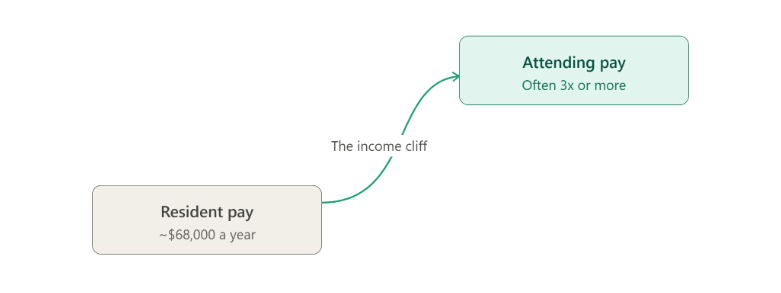
Doctors take a strange financial path. You spend a decade-plus training while earning a resident’s stipend, around $68,000 a year at the time of this writing,1 often with a mountain of student loans sitting there waiting. Then one day you finish training, you’re finally an attending, and your pay can more than triple almost overnight.
So the question is whether you actually need a financial plan this early, before you’ve built up much wealth. The answer is yes.
Why Physicians Can Benefit From a Plan Earlier Than They Think
A financial plan is just a game plan for your money. It answers where your dollars go, which goals come first, how one choice affects another, and what you’re building toward. It’s bigger than a budget or a couple of investment accounts; those are just pieces of it.
And time is the one advantage you can’t get back. The table below shows a simple, hypothetical comparison of investing $1,000 a month starting at 30 versus starting at 40.
| Start Age | Monthly Investment | Assumed Return | Approx. Value at 60 |
| 30 | $1,000 | 7% average | ~$1.2 million |
| 40 | $1,000 | 7% average | ~$520,000 |
Please Note: That example is hypothetical and for illustration only. It assumes a steady 7% average annual return, which actual markets don’t deliver in a straight line, and it ignores taxes and fees. Your real-world results will differ.
An Early-Career Plan Coordinates the Decisions That Matter Most
As a new attending, you’re trying to do two big things at once: get stable around your new paycheck, and start turning that higher income into lasting wealth and future freedom. Those pull in different directions if you don’t have a plan tying them together.
And these decisions are all connected. Your student loan strategy changes how much cash you have to work with. Your tax choices affect how you save. Insurance protects the income the whole plan runs on. And a big lifestyle jump can eat the money meant for everything else. A plan keeps them working together instead of fighting.
The Four-Piece Foundation: What to Sort Out First
Before the fancy stuff, you need a solid foundation. In order to build one, get these four things sorted:
- Your actual take-home pay. Build your plan around what actually lands in your bank account, after taxes, benefits, insurance, and retirement contributions, rather than your contract salary. That contract number always looks bigger than what you get to spend. If you have bonus or productivity pay, treat it as a nice extra rather than a bill you count on.
- A direction for your student loans. Pick a strategy instead of just paying the minimum and hoping. That might be PSLF (Public Service Loan Forgiveness, which wipes out your remaining federal loans after 10 years of payments while you work for a nonprofit or government employer), refinancing for a lower rate, paying them off fast, or a mix. The goal is to actually choose rather than let the loans drift.
- A cash cushion. Keep some money easy to reach for the normal emergencies plus the doctor-specific ones: moving for a job, a gap between positions, or a credentialing delay that holds up your first paycheck. This cushion keeps a surprise from forcing you into debt or making you sell investments at a bad time.
- Protection for your income. More than 1 in 4 of today’s 20-year-olds will deal with a disability before they retire.² Your earning capacity is your single biggest asset right now, so protect it. Look into own-occupation disability insurance (it pays you if you can’t work in your specific specialty, even if you could do some other job), term life insurance if anyone depends on you, and make sure your malpractice coverage and beneficiaries are squared away.
That does not mean the base has to be perfect before you move on. It means these four pieces deserve a first pass before your bigger income gets pointed anywhere else.
Then, Point your Bigger Income Somewhere
Once the base is set, that bigger paycheck needs a job. Because it’s easy to let it just disappear, decide ahead of time where it goes:
- Your workplace retirement accounts: Learn your employer’s match (free money you get just for contributing), the vesting rules (how long until that money is truly yours), and which accounts you have, like a 401(k), 403(b), or 457(b) (all tax-advantaged retirement accounts, the letters just refer to different employer types). Then decide how hard to fund them, and whether pre-tax or Roth (pay tax now, withdraw tax-free later) fits you better.
- HSA and Roth planning: If you have an HSA-eligible health plan, a Health Savings Account is a rare triple tax break worth using. And here’s a physician-specific catch: once you earn more than about $168,000 single (or $252,000 married), you can’t put money straight into a Roth IRA, at the time of this writing.4 That’s where the “Backdoor Roth” comes in, a legal workaround to get money into a Roth anyway. However, you must follow several details to do a Backdoor Roth IRA correctly.
- Savings you can actually reach: Not every dollar belongs in a retirement account you can’t touch until 59½. Keep some in regular, accessible investments for the goals that show up sooner: a house, a wedding, a kid, buying into a practice, or cutting back your hours someday.
- A savings rate you set on purpose: Decide how much you’ll save before your spending balloons to match your income. Build in room to actually enjoy the money you worked so hard for, but know your number, so lifestyle creep doesn’t slowly swallow your future.
Pro-Tip: Before doing a backdoor Roth, check whether you’re holding any pre-tax money in a traditional, SEP, or SIMPLE IRA. The IRS pro-rata rule looks at all your IRA dollars together, not just the new contribution, which can turn part of your “tax-free” conversion into a taxable one. Clearing out or rolling in that pre-tax balance first, often into a workplace 401(k) that accepts rollovers, is worth understanding well before you convert.
The goal is not simply to save more. The goal is to strengthen the base you already built, so growing, protecting, and eventually spending your wealth all point in the same direction.
How This Looks in Practice – A New Attending’s First-Year Plan
Setting: Dr. Scott, a first-year attending in internal medicine, six months out of residency, with roughly $190,000 in federal student loans and a new employed position offering a 401(k) match.
Situation: Dr. Scott’s take-home pay had nearly tripled overnight, but there was no strategy yet for the loans, no disability coverage beyond a thin employer policy, and a growing temptation to upgrade the apartment and the car at the same time.
- Calculated actual take-home pay after taxes, benefits, and retirement contributions, rather than budgeting off the contract number.
- Compared refinancing against staying on an income-driven repayment plan, and chose refinancing once it was confirmed PSLF was not a realistic path in this role.
- Added a supplemental own-occupation disability policy on top of the employer group plan, since the group policy alone would not have replaced enough income.
- Set a savings rate before signing a new apartment lease, so the higher rent didn’t quietly eat the amount meant for saving and loan payoff.
Result: Within the first year, Dr. Scott had a clear loan payoff timeline, a fully funded cash cushion, real income protection, and a savings rate locked in before lifestyle spending had the chance to expand and claim that room instead.
Starting Early Makes It Easier to Adapt as Your Career Changes
One of the best things about planning early is that your plan isn’t meant to sit frozen. Your first few years out of training can change fast, and a plan you already have is way easier to tweak than one you have to build from scratch mid-crisis. Revisit it when life shifts:
- Going from resident or fellow to attending, when your pay, taxes, benefits, loan options, and cash flow can all change at once. This is the big one.
- Switching employers or how you’re paid, since your retirement benefits, bonuses, insurance, and even your PSLF eligibility can change with the job.
- Getting married, having kids, buying a house, or moving, all of which change how much you can save and how much protection you need.
- Moving into partnership, practice ownership, or serious 1099 work (getting paid as a contractor instead of an employee), which shakes up your taxes, benefits, and risk.
- Any meaningful change in your loan plan, income, health, or family, so your plan reflects your actual life instead of old assumptions.
- A regular check-in, once a year is plenty, to see whether your savings, debt payoff, investments, and protection are all moving the right way.
The whole point of an early plan is that it grows with you.
Early-Career Financial Plans for Physicians FAQs
1. Do physicians need a financial plan while still in residency or fellowship?
It’s a great time to start a simple one. You’re not investing much yet, but decisions about your loans, your budget, disability insurance, and your first job contract all benefit from a plan. Getting the framework in place before your attending paycheck hits makes that jump way smoother.
2. What should an early-career physician financial plan include?
The basics first: your actual take-home pay, a loan strategy, a cash cushion, and income protection like disability and life insurance. Then the growth side: workplace retirement accounts, HSA and Roth planning, accessible savings for near-term goals, and a savings rate you set on purpose.
3. Is becoming a physician financially worth it?
For most, yes, but it’s a delayed payoff. You spend years earning little and taking on debt, then your income jumps a lot. A plan helps you make the most of that jump instead of letting higher taxes, loans, and lifestyle creep eat it up.
4. At what age do most doctors pay off their debt?
It varies a lot by specialty, debt load, and strategy, but many physicians aren’t debt-free until their late 30s or into their 40s. A clear loan plan early on, and sticking to it, is what shortens that timeline.
5. Is $200,000 enough to work with a financial advisor?
There’s no magic number. What matters more is how many important decisions you’re juggling, loans, insurance, taxes, a new contract, than the size of your accounts. Plenty of early-career physicians get genuine value from planning long before they hit any particular balance.
6. How often should an early-career physician update their financial plan?
Check in once a year, and any time something big changes: a new job, a move, marriage, kids, or a shift in your loans or income. Early on, life changes fast, so your plan should keep up.
How Our Team Helps Early-Career Physicians Build a Financial Plan
Everything above comes back to one idea: your income, your loans, your taxes, and your protection are not separate projects. They are one plan.
So no, you don’t have to wait until you’re rich to get value from a financial plan. Early on, it’s really about giving your new income and your growing list of decisions a clear direction, so they work together instead of pulling apart. That’s what our team does with early-career physicians. We help you figure out what needs attention now, what can wait, and how the pieces, loans, taxes, insurance, saving, and lifestyle, fit together, instead of tackling each one in a vacuum.
You do not need a complete plan, or even every answer, before reaching out. As you move through the big changes, a new job, more income, marriage, kids, we help keep the plan current and pull in your tax or legal pros when it makes sense.
If you’d like to talk it through, schedule a free Icebreaker Call with our team.
Resources:
1) AAMC: Survey of Resident/Fellow Stipends and Benefits
2) U.S. Bureau of Labor Statistics: Physicians and Surgeons
3) Social Security Administration: Disability Facts
4) IRS: 401(k) and IRA Limits for 2026 (Roth IRA Income Phase-Out)
Disclosures: WealthKeel Disclosures