
Key Takeaways:
- 20% of gross income is a common baseline: Given the late start in medicine, many physicians treat 20% as a floor rather than a target. The right figure depends on your income, debt, and when you want work to become optional.
- The target tends to rise mid-career: With income near its peak and loans shrinking, many physicians aim for 25%–30% during these years, which often do more of the heavy lifting than any others.
- Later, the math works backward: Near retirement, comparing what you have to what you’ll need usually matters more than any fixed percentage, and 2026 catch-up rules change how those extra contributions are taxed.
youtube.com/watch?app=desktop&v=wJzVhcj6Z30&ra=m&themeRefresh=1
The average U.S. physician earned about $386,000 in 2025, according to Medscape’s 2026 compensation report.¹ But a high salary doesn’t build wealth on its own; what you save from it does. And because physicians start their careers late and often deep in debt, how much you save, and when, matters more for you than for most people.
The right savings amount isn’t the same at every stage. A new attending, a mid-career specialist, and a doctor five years from retirement each face a different math problem, so the target often shifts as you move through your career.
The 20% Baseline and How It Shifts by Career Stage
Most physicians may want to save about 20% of gross income for retirement, and many benefit from treating that figure as a floor rather than a ceiling. One guideline cuts across every stage, but how you reach it, and how far past it you go, tends to change as your career does.
Early Career: Lock In a Strong Savings Rate
In the first few attending years, reaching a 20% savings rate as early as practical may matter more than the exact percentage, because the habits formed here often set the pattern for the rest of your career.
Your first years as an attending set the pattern for everything after. When your income jumps from a resident’s salary to a full physician’s, it’s tempting to let your spending jump with it. The doctors who build wealth fastest avoid that trap and route a big share of the raise straight into savings.
Reaching at least a 20% savings rate as soon as you can, counting retirement accounts and any employer match, is a common early goal. Money saved in your 30s has 30-plus years to grow, so a dollar saved now can be worth far more than a dollar saved in your 50s. Even while paying down student loans, saving something, especially enough to get a full employer match, is worth it.
Pro-Tip: Before your first backdoor Roth contribution, check for any pre-tax IRA balances, including a SEP-IRA (and SIMPLE IRAs) from moonlighting or locums income. Because of the pro-rata rule, those balances can make part of the conversion taxable, and rolling them into your workplace plan first (if it accepts rollovers) may avoid that.
Mid-Career: Push Past 20% While You Can
Mid-career is often the best window to push savings to 25%–30% of gross income, since income tends to be near its peak and student loans are shrinking or gone.
Mid-career, roughly 5 to 15 years in, is when your income is high and your loans are often shrinking or gone. This is often the best window to save aggressively and make up for the late start.
The money that used to go to student loans may be worth redirecting to savings rather than to a bigger lifestyle. A common order is filling tax-advantaged accounts first, then adding a taxable account for anything beyond that. These years do more of the heavy lifting than any other, because you have both a high income and time still on your side.
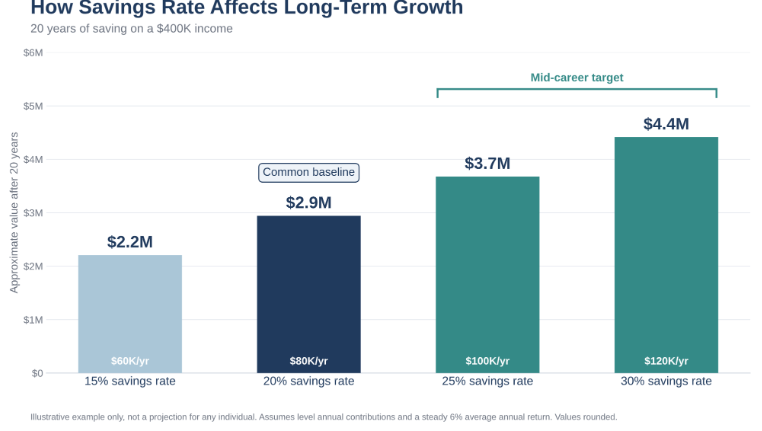
The difference between a 20% and a 30% savings rate can look small year to year. Over a career, it often isn’t.
How Savings Rate Affects Long-Term Growth (Illustrative)
| Annual Savings Rate | Yearly Savings on $400K Income | Approximate Value After 20 Years |
| 15% | $60,000 | $2.2M |
| 20% | $80,000 | $2.9M |
| 25% | $100,000 | $3.7M |
| 30% | $120,000 | $4.4M |
Assumes a steady 6% average annual return and level contributions. Figures are rounded and illustrative, not a projection for any individual; actual results will vary with markets, taxes, and income changes.
Established Career: Save to Close the Gap
Later in your career, the right savings amount generally comes from working backward from your retirement target rather than from a fixed percentage.
Later in your career, a flat savings rate stops being the right guide. Work backward from your retirement number instead: estimate what you’ll spend each year in retirement, multiply by about 25 to get a rough target, then compare it to what you have.
If there’s a gap, closing it may mean saving well above 20% in your final working years. Catch-up contributions let people 50 and older put extra into their retirement accounts, though for most physicians those catch-ups now have to go in as Roth, and a paid-off mortgage or grown children can free up more to save. If you’re already on track, this stage shifts to protecting what you’ve built and planning how to turn it into income.
Pro-Tip: For 2026, the 401(k) and 403(b) catch-up limit is $8,000 at age 50+ and $11,250 at ages 60–63. If your FICA wages from that employer were above $150,000 in 2025, those catch-up dollars must go in as Roth rather than pre-tax, so it’s worth confirming your plan offers a Roth option before you elect them.³
Please Note: The percentages here are general guidelines, not exact targets. The right savings rate for you depends on your income, debt, spending, when you started, and when you want to retire. Two physicians the same age can need very different amounts.
What Should Count Toward a Physician’s Savings Target?
A physician’s savings rate generally includes every dollar put toward the future, not just what lands in a 401(k). The main pieces:
- Workplace retirement accounts: Your 401(k) or 403(b), and a 457(b) if your employer offers one. These are usually the first place to save, especially up to any employer match, which is effectively part of your compensation.
- Employer match: If your employer adds money when you contribute, that counts toward your total. Contributing at least enough to receive the full match is often one of the first priorities worth setting.
- Backdoor Roth IRA: Most physicians earn too much to put money into a Roth IRA directly, but a “backdoor” Roth is a legal workaround that gets money into one anyway. It grows tax-free, which is valuable over a long career. Existing pre-tax IRA balances, including SEP-IRAs from moonlighting or locums work, can trigger the pro-rata rule, so reviewing those balances first may help avoid an unexpected tax bill.
- Health savings account (HSA): If you have a high-deductible health plan, an HSA offers a rare triple tax break (tax-deductible contributions, tax-free growth, and tax-free withdrawals for qualified medical expenses) and can double as a retirement account for medical costs later.
- Taxable brokerage account: Once your tax-advantaged accounts are full, a regular investment account holds the rest. It’s flexible money you can reach before retirement age, which matters if you want to cut back early.
A Simple 4-Step Way to Calculate Your Savings Rate
- Start with gross income: Use your total annual compensation before taxes, including bonuses, call pay, or partnership distributions.
- Add up every dollar saved: Include your own retirement contributions, your employer’s match, backdoor Roth and HSA contributions, and money added to a taxable brokerage account.
- Include extra principal, if you choose: Some physicians count extra student loan principal beyond the required payment, since it raises net worth the same way saving does. Deciding this once and staying consistent matters more than which way you choose.
- Divide and review once a year: Divide total savings by gross income, then compare the result to the target for your career stage. A yearly check, or one after a raise or new contract, is usually enough.
How This Looks in Practice – An Emergency Physician Six Years Into Practice
Setting: Dr. Halpert, a 37-year-old emergency physician, six years into an employed hospital position, married with one child.
Situation: Dr. Halpert’s household income had grown to $420K-$450K, and he had just made his final student loan payment of about $2,400 per month. He was contributing enough to his 403(b) to get the match, which put his savings rate at roughly 14%. Most of each raise since his first attending year had gone toward a larger home and higher monthly spending.
What he did:
- Redirected the loan payment: Set up an automatic transfer of the full $2,400 per month to savings starting the month after payoff.
- Filled tax-advantaged space: Increased his 403(b) to the full employee limit, opened backdoor Roth IRAs for himself and his spouse, and began funding the HSA available through his high-deductible plan.
- Reviewed the 457(b): Confirmed his hospital’s plan was governmental, then began contributing a portion of his next raise to it.
- Set a taxable account for flexibility: Directed anything beyond the tax-advantaged accounts to a taxable brokerage account earmarked for possible reduced shifts in his 50s.
Result: Within twelve months, Dr. Halpert’s savings rate rose from about 14% to about 27% without a noticeable change in the family’s day-to-day spending, and his projected work-optional window moved several years earlier.
How Much Physicians Should Save FAQs
1. How much money does the average physician save for retirement?
It varies widely, and many physicians save less than they should for their income. A common guideline is 20% of gross pay, but surveys suggest plenty of doctors fall short, often because lifestyle spending climbs along with their salary. What matters is your own rate rather than the average, since a high income can hide a low savings rate.
2. Is $5 million enough to retire at 70?
For most physicians, yes, likely with room to spare. A rough guide is that you can spend about 4% of your savings a year, so $5 million could support around $200,000 a year before taxes, on top of Social Security. Whether it’s enough depends on your spending, your health costs, and how long you need it to last, but $5 million puts most retirees in a strong position.
3. Do most doctors retire as millionaires?
Most do. Medscape’s 2026 report found roughly 6 in 10 physicians have a net worth above $1 million, and many go well beyond it.² But a meaningful number don’t, usually because they saved too little relative to their income. A strong, steady savings rate separates the two groups far more than how much they earned.
4. What percentage of income should a physician save during the first five years as an attending?
Aim for at least 20% of your gross income, and more if you can manage it. Those first years are the most valuable for long-term growth, so the higher your rate early, the less you’ll have to scramble later. Getting the full employer match and starting a backdoor Roth are good first steps.
5. Should physicians increase their savings after paying off student loans?
Yes, and it’s one of the biggest missed opportunities. When a loan payment disappears, that money should shift into savings rather than into a bigger lifestyle. Redirecting even part of a former loan payment into retirement accounts can add up to a large amount over time.
6. How can physicians tell if they need to save more later in their careers?
Compare what you have to what you’ll need. Estimate your yearly retirement spending, multiply by about 25 for a rough target, and see how close your current savings are. If there’s a gap, or if you started saving late, you likely need to save more in your remaining working years. An advisor can run the numbers with you.
7. Does my employer match count toward my 20% savings rate?
Most physicians include it, since the match is money going toward retirement on your behalf. What matters most is being consistent: if you count the match, count it every year so you can compare your rate over time. If you’d rather hold yourself to a higher standard, you can target 20% from your own contributions alone and treat the match as a bonus.
Get Help Setting the Right Savings Target
How much you should save changes as you move through your career: build a strong rate early, push past 20% in your peak earning years, and save to close the gap as retirement nears. For physicians, who start late and earn well, getting this right early is one of the most valuable financial moves you can make.
We help physicians figure out the right number at every stage. We can set a savings target based on your income, debt, and goals, make sure it counts every account available to you, and adjust it as your career and your loans change.
If you’re not sure whether you’re saving enough, or where to put the money, we’d be glad to help you find out. Schedule a free Icebreaker Call with our team.
Resources:
- Medscape: Physician Compensation Report 2026
- Medscape: Physician Wealth & Debt Report 2026, https://www.medscape.com/p11/medscape-physician-wealth-debt-report-2026-rising-net-worth-2026a10009up
- IRS: 401(k) Limit and Catch-Up Contribution Updates for 2026
Disclosures: WealthKeel Disclosures