
Key Takeaways:
- The real trigger is overlap, not income. Once your student loan strategy, tax bracket, retirement contributions, and insurance decisions start affecting one another, they typically become harder to manage as separate problems.
- Certain career moments concentrate decisions. A first attending contract, a partnership buy-in, or a stretch five to ten years from retirement can put several major choices in front of you at once, often within the same few months.
- Timing matters more than net worth. Advice tends to be most useful while a decision is still open, before a contract is signed or a buy-in is funded, rather than after the fact.
Medical training is expensive, and the bill typically comes due right as the paycheck changes. The average medical school graduate carries close to $200,000 in student loans,¹ and that debt usually follows a physician straight into residency, then into the first attending role, where a much larger salary comes with loan repayment choices, new tax brackets, and a first real chance to invest.
Earning a physician’s income does not, by itself, mean you need a financial advisor. For many doctors, help starts to make sense at a specific point: when income, taxes, debt, insurance, and long-term goals stop behaving like separate line items and start moving together.
We’ll walk through what that overlap tends to look like, which career moments make it worse, and how to tell whether you’re better served managing things yourself for now.
When Does Hiring an Advisor Start to Make Sense?
You can be genuinely good with money and still reach a point where handling every piece yourself stops being the best use of your time. A few patterns tend to show up first.
Direct answer: Advice generally becomes worth paying for once your decisions interact, the stakes grow, or the coordination itself becomes the hardest part of the job.
- Your decisions start affecting each other: How you pay down student loans can shape your monthly cash flow, your tax bill, and how much you’re able to save. Solving one in isolation often means missing how it shifts the other two.
- The stakes get bigger: More income, more savings, and a growing family generally mean a mistake costs more. A misstep on taxes, coverage, or timing can take years to fully unwind.
- The complexity compounds: Multiple accounts, K-1 income from a practice, employer benefits, and maybe a side business all run on different rules. At some point, managing the system as a whole may beat solving each piece on its own.
- The time simply is not there: You may know exactly what needs to happen and still never get to it between call shifts, clinic days, and everything else. A good advisor typically builds a system that keeps moving without needing your attention every week.
- You want to pressure-test a big decision: Cutting back hours, buying into a practice, switching groups, or retiring early are easier to evaluate in advance. An advisor can typically model how a single move ripples through your taxes, your cash flow, and your savings before you commit.
Pro-Tip: If you’re a 1099 physician or practice owner, the IRS generally expects quarterly estimated payments, and underpayment penalties can apply even if you pay the full amount by April. Reviewing your estimated payment schedule each quarter, rather than once a year, helps catch shortfalls while you still have time to fix them.
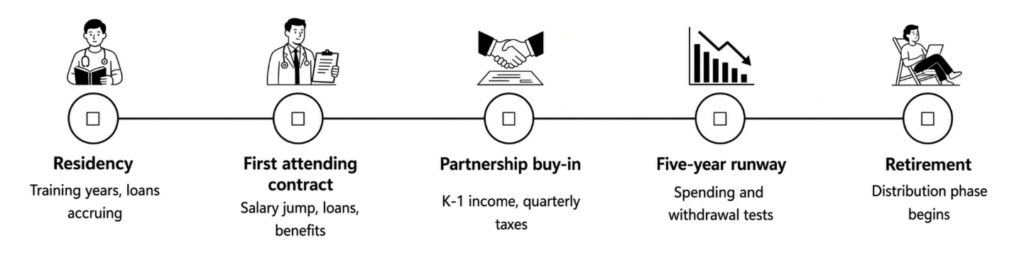
Career Moments That Concentrate Financial Decisions
There’s no magic age, salary, or savings number that means “now hire someone.” What matters is timing, because certain stretches of life cram a ton of decisions into a short window. And advice helps most before you’ve locked things in, since a big change in your income, your job, or your family can throw off the whole system you’d set up.
Early- and Mid-Career Moments
Early and mid-career changes tend to bring a jump in pay before your money system has caught up. A little planning helps point that new money somewhere useful before it gets swallowed by bigger bills.
A few moments are worth a close look:
- Finishing training or starting your first attending job: The jump from residency (that’s your training years) to your first full doctor job can pile contract details, moving costs, benefits, loans, and disability insurance into the same couple of months. Sorting it out before that first big paycheck gives the money a plan.
- Changing jobs or how you get paid: A new hospital or group can change your salary, bonuses, retirement contributions, old work accounts, and insurance. Looking past just the base salary tells you what the move actually means for you.
- Marriage, kids, and a growing net worth: Getting married, having kids, buying a house, saving for college, taking on more debt, these change how much you need to save and how much you need to protect. It’s usually when things like life insurance and estate planning (basically, a plan for who gets what) deserve a proper look.
Ownership and Later-Career Moments
Later on, you might add ownership, bigger tax bills, or big one-time money decisions, often with less time to fix mistakes. For a lot of doctors, setting things up right ahead of time keeps more options open later.
A few spots where coordinated advice really earns its keep:
- Becoming a partner, owning a practice, or going 1099: Owning a piece of the business (1099 means you’re paid as a contractor instead of an employee) adds things like uneven pay, quarterly taxes you have to send in yourself, cash reserves, and buy-in costs. A physician-focused advisor keeps your accountant, lawyer, and everyone else on the same page.
- A big money event: Selling a practice, an inheritance, a buyout, or a big chunk of company stock brings new questions about taxes and what to do with the money. It’s best to plan before the money moves, while you still have choices.
- Five to ten years from retiring (or slowing down): This is when retirement planning gets concrete. You can test out your spending, healthcare, and how you’ll pull money from your accounts while there’s still time to adjust.
A Simple Framework for Testing a Big Decision Before It’s Final
Before signing a contract, funding a buy-in, or accepting a new compensation structure, it can help to run the decision through a short, ordered check rather than reacting to it in isolation.
- Map the cash flow impact. Estimate how the decision changes take-home pay, monthly obligations, and savings capacity over the next 3–8 years.
- Check the tax consequences. Identify whether the change shifts your bracket, your quarterly obligations, or your access to certain deductions and retirement contributions.
- Stress-test the downside. Ask what happens to the plan if income drops 20–30%, a partnership stalls, or a job change falls through.
- Confirm it still serves the goal. Compare the decision against what you’re actually trying to build, whether that’s more time, more flexibility, or a specific retirement date, rather than against the decision in isolation.
The goal is not to avoid the decision. The goal is to make it with the full picture in view.
When You’re Probably Fine on Your Own
Some doctors have a pretty simple setup, actually enjoy managing their own money, and have the time to keep up with it. If that’s you, doing it yourself can work great.
Just know that good do-it-yourself money management is more than picking investments. You also need a regular habit of checking your benefits, taxes, loans, insurance, and who’s listed to inherit your accounts, and catching the life changes that shift the plan.
And sometimes you just need a specialist for one thing rather than an ongoing advisor. An accountant can handle a tax question, a lawyer a contract, an insurance agent your coverage. You mainly need someone tying it all together once those pieces start affecting each other.
The simplest test is whether your system actually works. If checking your finances and making changes fits into your life without stuff slipping through the cracks, keep doing it yourself. If tasks keep piling up, or one choice keeps causing problems somewhere else, it might be time for ongoing help.
| Approach | Best fit for | What it typically covers | Where it tends to fall short |
| Do-it-yourself | Simpler finances, hands-on physicians with time to spare | Investment selection, basic budgeting, routine account maintenance | Coordinating taxes, benefits, and insurance as they shift together |
| One-time specialist | A single, contained question | A contract review, a tax filing, a coverage gap | Ongoing changes across the plan as income or life circumstances shift |
| Ongoing financial planning | Overlapping decisions, limited time, major life or career transitions | Cash flow, tax strategy, retirement, insurance, and estate planning as one coordinated system | Costs more than a single specialist engagement |
What to Look for in a Physician-Focused Advisor
Once you’ve decided help may be worth it, the details of who you work with tend to matter more than the decision itself.
Direct answer: Look for physician-specific experience, clarity on whether the relationship covers full planning or investments alone, transparency on fees and fiduciary status, and a willingness to work alongside your existing accountant and attorney.
- Physician-specific experience: Someone familiar with residency pay, attending compensation structures, and physician retirement accounts like 403(b)s and 457(b)s tends to give more relevant advice than a generalist. Backdoor Roth IRAs are another topic that most generalist financial planners fail on with the physician community; unfortunately, we see it way too often.
- Scope of service: Some advisors manage investments only; others coordinate loans, benefits, taxes, and career decisions as one plan. It’s worth confirming which one you’re getting before signing anything.
- Fee structure and fiduciary status: Understanding how an advisor is compensated, what conflicts may exist, and whether they’re legally required to act in your interest (a “fiduciary”) tends to clarify what you’re actually paying for.²
- Willingness to coordinate: A good advisor typically works with your accountant and attorney rather than working around them, keeping each specialist focused on their piece while pointing toward the same goals.
- Fit with how you actually work: Regular check-ins, plain-English explanations, and help with follow-through can matter as much as the plan itself, particularly if you have no interest in becoming your own financial expert.
How This Looks in Practice – A Partnership Buy-In
Setting: Dr. Kapoor, a general surgeon eight years into practice, was offered partnership at her group, with a buy-in due within 18 months.
Situation: The buy-in would shift a meaningful share of her income from W-2 to K-1, change her tax filing obligations, and require a lump-sum contribution funded partly through savings and partly through a practice loan.
- Modeled the buy-in cost against 3–5 years of projected cash flow before accepting the offer.
- Adjusted her withholding and set up quarterly estimated payments ahead of the K-1 income shift.
- Reworked disability and malpractice coverage to reflect her new ownership stake.
- Coordinated the loan terms with her attorney before signing the partnership agreement.
Result: Dr. Kapoor entered the partnership with a funded buy-in plan, no surprise tax bill in year one, and updated coverage that matched her new risk exposure, rather than discovering the gaps after the fact.
When Physicians Should Hire a Financial Advisor FAQs
1. Does every physician need a financial advisor?
Nope. Plenty of doctors handle their own money just fine for years. If your setup is simple, you like doing it, and you actually keep up with it, doing it yourself is totally fine.
2. How much money do I need before hiring one?
There’s no magic number. What matters is how much is going on in your financial life and how much it all needs to be coordinated, way more than hitting some dollar amount.
3. Should a resident or fellow hire one before becoming an attending?
It can be a smart move, especially when a job contract, a first proper budget, benefits, loans, and insurance all need attention at once. Planning before the bigger paycheck shows up makes the whole jump easier.
4. When should a practice owner or 1099 physician think about it?
When the business starts affecting your personal taxes, savings, cash flow, or buy-in costs. Owning part of a practice blurs the line between your personal money and the business’s money enough that having someone coordinate it really pays off.
5. I already invest well. Can planning still help me?
Yep. Being good at investing doesn’t automatically cover taxes, loans, benefits, insurance, and career decisions. A full planning relationship ties all of that together so your future stays flexible.
6. Do I need ongoing help or just help with one decision?
One-time help is great for a single question you’re comfortable handling yourself. Ongoing help fits better when your decisions affect each other all year and you want your plan kept up to date as life changes.
Build a Money Plan That Grows With Your Career
The right time to get help really comes down to what your financial life is asking of you right now. As your career grows and things get more complicated, good advice gives you clearer choices, better follow-through, and more control over what’s next.
Our team works with doctors at every stage, and we can tie together your loans, benefits, investing, insurance, family goals, and retirement around the life you’re trying to build. That gives you one place to weigh your options instead of juggling them all yourself.
With us as a second set of eyes, your accountant, lawyer, and insurance agent stay focused on their part while we keep the big picture organized. If you want to talk through where you’re at, schedule a free Icebreaker Call with our team.
Resources:
2) SEC: Investment Adviser Conduct Standard
Disclosures: WealthKeel Disclosures