
Key Takeaways:
- A high income doesn’t make prioritizing easier. It just raises the stakes, since several good goals compete for the same dollars, so the order you fund them in matters as much as the amount.
- Protect the base before you reach for returns. A cash reserve, disability coverage, and the full employer match come before maxing accounts or paying extra on low-rate loans.
- Build it once, then automate it. Turning your priorities into a simple Now, Next, and Later system means you’re not re-deciding where every dollar goes each payday.
https://www.youtube.com/watch?v=Hn3tKmfjLis
Few professionals juggle as many financial decisions on as little time as physicians do. You start earning a full attending income a decade later than your peers, often while carrying the roughly $223,130 in student debt that new physicians who borrowed finished school with,1 and then peak earnings, family, employer benefits, taxes, and years of catch-up saving all land at once, competing for the same paycheck.
A high income helps, but it doesn’t erase the tradeoffs. It can even hide them, since there’s usually enough cash to start several goals and never quite finish any. The fix isn’t more income. It’s a priority system that gives each dollar a clear job based on risk, timing, and where you are in your career. Done well, it works: 63% of physicians now report a net worth over $1 million, and 19% top $5 million, up from 11% just three years earlier.2
Put Your Financial Foundation and Highest-Value Opportunities First
Most physicians earn enough to chase several worthwhile goals at once. The trap is treating them all as equally urgent, which spreads your cash flow thin and leaves the biggest risks sitting unprotected while you optimize something smaller.
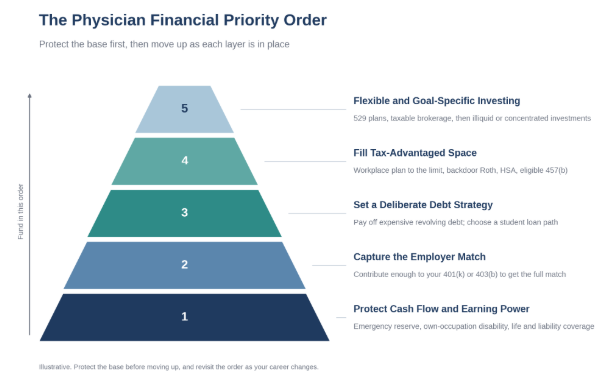
A cleaner approach is to protect your current stability and earning power, grab the high-value opportunities you can’t get back later, settle how you’ll handle debt, and then push additional money toward long-term and goal-specific savings.
Protect Your Cash Flow and Earning Power
Before you optimize anything, make sure one bad month can’t unravel the whole plan. The base layer is about staying stable and protecting the income everything else depends on:
Emergency Reserve: Three to six months of core expenses is a starting range rather than a universal answer. Lean higher if your pay is variable, you own your practice, your household runs on one income, or a leave or job change is on the horizon.
Disability Coverage: For most physicians, future earning power is the largest asset the household owns, bigger than any account. Look for a physician-specific own-occupation definition, and check your employer coverage against an individual policy rather than assuming the group plan is enough.3
Life and Liability Protection: If someone depends on your income, term life insurance belongs here, along with solid liability coverage, current beneficiary designations, and basic estate documents. The point is keeping one major loss from wiping out every other goal.
Capture Employer Benefits and Choose a Deliberate Debt Strategy
Once the base is set, the first dollars usually go to your employer match. Contributing enough to your 401(k) or 403(b) to capture the full match is close to free money, though it’s worth checking the vesting schedule if a job change might be coming.
Debt comes next. Expensive revolving debt like credit cards usually deserves aggressive payoff, while lower-rate mortgages and student loans are better weighed against your other goals than rushed. Your student loans in particular deserve their own decision: pursuing Public Service Loan Forgiveness points you one way, while refinancing or accelerated payoff points another, and a physician chasing forgiveness generally shouldn’t send extra payments toward loans they expect to have forgiven.
Before committing, confirm your loan type, employer eligibility, repayment plan, and qualifying-payment count under current rules, since PSLF generally requires Direct Loans and 120 qualifying monthly payments while you work full time for an eligible employer.4
Build Beyond the Match With Tax-Advantaged and Flexible Accounts
After the match and your debt plan are in place, the next priority is filling tax-advantaged space in a sensible order. For a high earner, there’s usually more room than you’d expect:
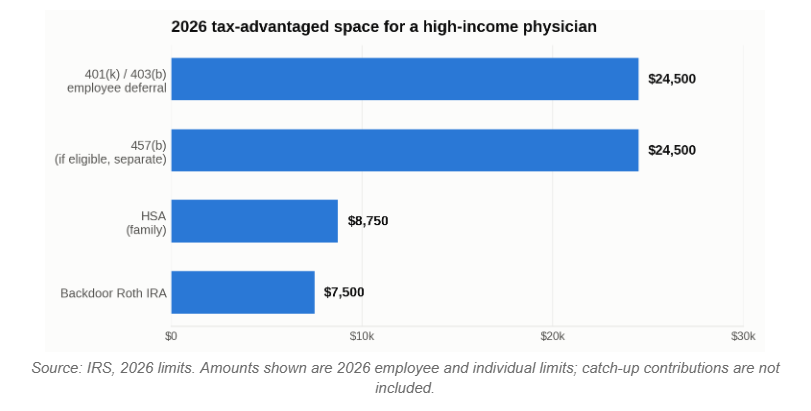
Additional Workplace Retirement Savings: Once you’ve captured the match, work toward the annual limit. For 2026, the base employee deferral across 401(k) and 403(b) plans is $24,500, and these plans generally share that single limit.5 Weigh pre-tax against Roth based on your bracket now versus later, and note that an eligible 457(b) can add separate deferral room on top.
Backdoor Roth IRA: High earners are usually phased out of direct Roth IRA contributions, so the backdoor route gets you there: contribute to a traditional IRA, then convert to Roth, with the 2026 IRA limit at $7,500. Report it on Form 8606, and watch the pro-rata rule if you hold pre-tax money in a traditional, SEP, or SIMPLE IRA, since it can make the conversion partly taxable.6
Health Savings Account: If you’re in an eligible high-deductible health plan, an HSA is the rare triple tax break: deductible or pre-tax contributions, tax-deferred growth, and tax-free withdrawals for qualified medical costs. The 2026 limits are $4,400 for self-only and $8,750 for family coverage.7 Just make sure the health plan itself fits your family’s medical needs.
Education and Flexible Investing: Get retirement on track before aggressively funding a child’s college, since there’s no loan for retirement. A 529 plan fits a defined education goal, a taxable brokerage account suits mid-term or early-retirement goals that need access, and concentrated, illiquid, or real estate investments come after the core plan is funded.
Please note: If you have a 457(b), check whether it is governmental or nongovernmental before treating it as an automatic next step. Money in a nongovernmental 457(b) stays the employer’s property and can be reached by the employer’s creditors, so the company’s financial strength and the plan’s distribution rules matter.8
Adjust the Order for Your Career Stage and Near-Term Demands
The order above is a sensible default, but it bends to your situation. Where you are in your career, and what’s coming up soon, can move items up or down:
Training and Early Attending Years: Residents, fellows, and brand-new attendings usually lead with cash reserves, insurance, the employer match, and a firm student-loan direction before trying to max every account. Retirement contributions can increase as your income climbs. For targets by stage, see how much to save at each career stage and net worth goals by career stage.
Established Attending Years: The focus shifts to consistently filling your tax-advantaged space, growing taxable investments, keeping tax diversification, and making sure lifestyle doesn’t swallow every raise.
Employment and Ownership Changes: Moving between W-2, 1099, partnership, or practice ownership can change your benefits, your retirement-plan options, your cash-flow swings, your loan-forgiveness eligibility, and how much you need to set aside for taxes or a buy-in.
Major Personal Goals and Transitions: Parental leave, a home purchase, a relocation, childcare, or a practice purchase can each pull cash savings temporarily higher in the order. A near-term deadline earns a short-term bump without permanently benching retirement.
Turn the Priority Order Into a System You Can Maintain
Knowing the order is half the job. The other half is making it run without a weekly budgeting session you don’t have time for.
A few moves turn the priority list into a system that mostly runs itself:
- Shrink the full list to a simple Now, Next, and Later. Give each active goal a target amount, a deadline, and a monthly contribution, so you’re not re-litigating where the next dollar goes every payday.
- Automate what you can: payroll deferrals, savings transfers, scheduled loan payments, and recurring investments. Put the once-a-year tasks, like a backdoor Roth or a benefits review, on a calendar.
- Decide in advance how raises, bonuses, and partnership distributions get split between your current priority, your next goal, and lifestyle. That keeps a bigger paycheck from turning straight into bigger fixed expenses.
- Run one thorough priority review a year, plus a quick one whenever your job, pay, family, loan-forgiveness plan, or ownership status changes. Re-rank when the facts change instead of letting an old automation run on autopilot.
- Keep your financial planner and tax professional working from the same priority list, since tax elections, retirement-plan choices, estimated payments, and practice income all change how much cash you actually have to work with.
How This Looks in Practice – A Mid-Career Hospitalist Weighing the Next Dollar
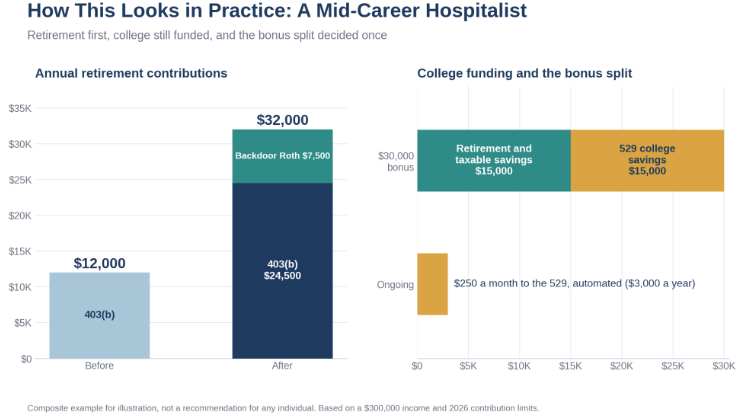
Picture a hospitalist eight years into practice, married with two kids, earning about $300,000 a year. She has $36,000 in cash, roughly three months of expenses, plus an own-occupation disability policy, and she’s putting $12,000 a year into her 403(b), enough to capture her full employer match. Her retirement balance sits around $210,000, which is light for her income, and she’s torn between funding college for the kids and putting more into retirement.
Run through the order and the answer gets clearer. Because there’s no loan for retirement, she raises her 403(b) from $12,000 to the 2026 limit of $24,500 and adds a $7,500 backdoor Roth, moving about $32,000 a year into retirement instead of $12,000. She keeps an automated $250 a month flowing into a 529 so college isn’t ignored, and when her $30,000 bonus lands, she splits it: $15,000 toward retirement and taxable savings, and $15,000 into the 529. One decision, made once, instead of a monthly debate.
Financial Goal Prioritization for Physicians FAQs
1. How do you build wealth as a physician?
Steady beats flashy. Protect your income, capture every employer match, keep expensive debt from lingering, and fund tax-advantaged accounts consistently as your pay grows. Most physician wealth comes from a high savings rate invested over time, not one clever move. For benchmarks, see net worth goals for physicians by career stage.
2. What percentage of income should a physician save each year?
A common starting point is around 20% of gross income toward retirement, often higher for physicians because of the late start and higher spending. The right number depends on your age, income, and goals. We break it down by stage in how much to save at each career stage.
3. Should a physician pay off a mortgage early or invest the extra money?
It depends on your mortgage rate, your tax situation, and whether you’re already funding retirement. With a low fixed rate, investing the difference often wins on the math, while a higher rate or a strong preference for being debt-free can tip it the other way.
4. Should physicians prioritize retirement savings or their children’s college funds?
Retirement usually comes first, because your kids can borrow for college but no one lends for retirement. Once your retirement savings are on track, funding a 529 makes sense. Many physicians do both at once, just weighted toward retirement.
5. How should a physician allocate a signing bonus or annual bonus?
Decide before it hits your account. A practical split sends part to your current top priority, part to your next goal or cash reserve, and a defined slice to enjoy. Pre-deciding keeps a bonus from turning into permanent lifestyle spending.
6. When should a physician consider working with a financial advisor?
It helps when your situation gets complicated: a new attending contract, practice ownership, PSLF decisions, a backdoor Roth, or just too many competing goals and too little time to manage them. A good advisor can turn the whole picture into one coordinated plan.
7. What is the most common financial-priority mistake physicians make?
Trying to do everything at once. Spreading cash thin across every goal often means the big risks, like being underinsured or under-saved, go unaddressed while smaller optimizations get the attention. A clear order fixes that.
Get Help Turning Competing Financial Goals Into a Clear Plan
The best priority order is structured but flexible. It should protect where you stand today, send money toward the opportunities that matter most, and shift as your career and family change.
WealthKeel works with physicians to look at the whole picture at once: cash reserves, insurance, employer benefits, student loans, taxes, retirement accounts, and near-term goals as one coordinated plan instead of a pile of separate decisions.
From there, the team can turn that plan into clear contribution targets, automations, and review points, so the decisions get easier and your time goes back to medicine and your family. If you’d like help sorting your competing goals into one clear order, schedule a free Icebreaker Call with our team.
Disclosures: WealthKeel Disclosures
Resources:
- Education Data Initiative, Average Medical School Debt (data from the AAMC)
- Medscape, Physician Wealth & Debt Report 2026
- American Medical Association, Assessing Physician Disability Insurance
- Federal Student Aid, Public Service Loan Forgiveness
- IRS, 401(k) and IRA Contribution Limit Increases
- IRS, About Form 8606
- IRS, Health Savings Accounts (Publication 969)
- IRS, IRC 457(b) Deferred Compensation Plans