
Last updated:
The physician mortgage loan, sometimes called the doctor mortgage loan, exists because medical professionals face a lending problem that doesn’t affect other careers. High student loan debt and a lower income during residency or fellowship limit savings and push the debt-to-income ratio higher than a conventional lender wants to see. Strained credit from those training years can make a standard mortgage harder to get or more expensive.
A physician mortgage offers flexible underwriting for doctors, dentists, veterinarians, and other qualifying professionals. Down payments as low as 0% are common. Income-driven repayment (IDR) student loan payments get counted instead of the full loan balance, and loan amounts can run well past conforming limits. Consider a resident earning $65,000, carrying $250,000 in student debt, and paying $300 a month under an IDR plan: many lenders will qualify that resident based on projected attending income rather than current pay. That’s why physicians often buy sooner instead of waiting years to save a 20% down payment.
This guide covers how physician mortgage loans work, their benefits and drawbacks, current rates and loan limits, and how to decide if one fits your plan.
Key Takeaways
- A physician mortgage allows eligible doctors to buy a home with little to no down payment.
- Student loans are often excluded or treated more flexibly in debt calculations.
- These loans typically avoid private mortgage insurance (PMI), even with a low down payment.
- Physician mortgage rates currently run about 0.125% to 0.50% above comparable conventional rates, a narrower gap than in past years.
- They’re best suited for high-income professionals early in their careers who value cash flow flexibility over the lowest possible rate.
🧭 Free Home-Buying Flowchart for Physicians
Not sure whether buying makes sense right now? Use our step-by-step decision flowchart to evaluate timing, affordability, and tradeoffs.
👉 What Issues Should I Consider When Buying a Home
Prefer video over the blog? We’ve got you covered
Watch our YouTube video as we break down this guide step by step.
Jump To:
- What Is a Physician Mortgage Loan?
- Benefits of a Physician Mortgage
- Drawbacks of a Physician Mortgage
- Who Qualifies?
- Monthly Costs
- Is It Right For You?
- Frequently Asked Questions
What Is a Physician Mortgage Loan?
A physician mortgage loan is a home financing option built specifically for medical professionals, including physicians, dentists, and veterinarians.
Residents and fellows earn far less during training than they will as attendings, so many lenders accept an offer letter or signed contract as proof of future income and underwrite against projected earnings rather than current pay. That lowers your DTI compared to counting a resident’s actual training salary against a full mortgage payment.
Here’s how it typically works. Lenders ask for proof of your degree, an employment offer or contract, recent pay stubs where available, and student loan documentation such as your IDR statement. Take the earlier example: a resident with a $65,000 stipend, $250,000 in debt, and a $300 monthly IDR payment can often qualify based on expected attending pay instead. For a detailed documentation checklist, see our underwriting guide and lender comparisons.
Benefits of a Physician Mortgage
Doctor mortgages provide a few targeted advantages that help medical professionals buy earlier than a conventional loan would allow.
Down Payment
Many programs reduce or eliminate the down payment, and most physician lenders waive PMI, the extra monthly cost that conventional loans charge under 20%.
Putting 0% to 5% down cuts the upfront cash you need, which matters most for doctors still carrying student debt. A larger down payment also lowers your monthly payment and builds equity faster, so it’s worth putting down what you can comfortably.
For example, skipping PMI on a $500,000 loan saves hundreds of dollars a month compared to a conventional loan at the same down payment. An FHA loan requires only 3.5% down but still charges mortgage insurance, so it doesn’t solve the same problem.
Debt-to-Income (DTI) Ratio
Conventional loans count your full student loan balance as a fixed monthly obligation. Physician loans use your actual IDR payment, or your training income, instead.
A low IDR payment keeps your DTI down, which lets you qualify for a larger loan. This matters most for residents and fellows on track to become attendings. On a $250,000 loan balance with a $300 monthly IDR payment, a physician lender counts that $300 in your DTI rather than the $2,000 or more a conventional lender might assume, freeing up room for a bigger mortgage.
Loan Limits
Conforming loan limits change every year based on FHFA data. For 2026, the baseline limit is $832,750 in most of the country, with a high-cost area ceiling of $1,249,125. Physician loans routinely exceed those numbers, often reaching $1 million to $2 million or more, depending on the lender.
That flexibility helps in expensive markets, since it removes the need for a large down payment just to close the gap between the purchase price and the conforming limit. Larger loans still mean larger payments and more total interest, so borrow within what your budget supports rather than what you’re approved for.
| Feature | Conventional | Physician Mortgage (2026) |
|---|---|---|
| Down Payment | 3–20% (PMI required under 20%) | 0–10%, often no PMI |
| DTI Calc | Full student loan balance | IDR payment only |
| Max Loan | $832,750–$1,249,125 (conforming) | $1M–$2M+ common |
| Typical Rate | ~6.95–7.0% (30-year, per Freddie Mac) | ~0.125–0.50% above conventional |
The benefits are real, but rates can still run higher than a comparable conventional loan. Shop more than one lender before committing, and watch for the common mistakes that trip up physician borrowers. See our Top 6 Money Errors Doctors Make for more.
🚀 Grab Your Free Physician Financial Playbook🩺
Everything you need to master debt, taxes, investing, and retirement—tailored for doctors.
📥 Download “A Doctor’s Prescription to Comprehensive Financial Wellness”
[Yes, it will ask for your email 😉]
Drawbacks of a Physician Mortgage
Physician loans open doors for early-career doctors, but you should understand the trade-offs before you commit. They affect cost, rate stability, and which properties qualify.
Interest Rates
Some physician mortgages carry variable rates that start low and rise over time, increasing your payment and total interest in ways that are easy to miss until you’re ready to refinance.
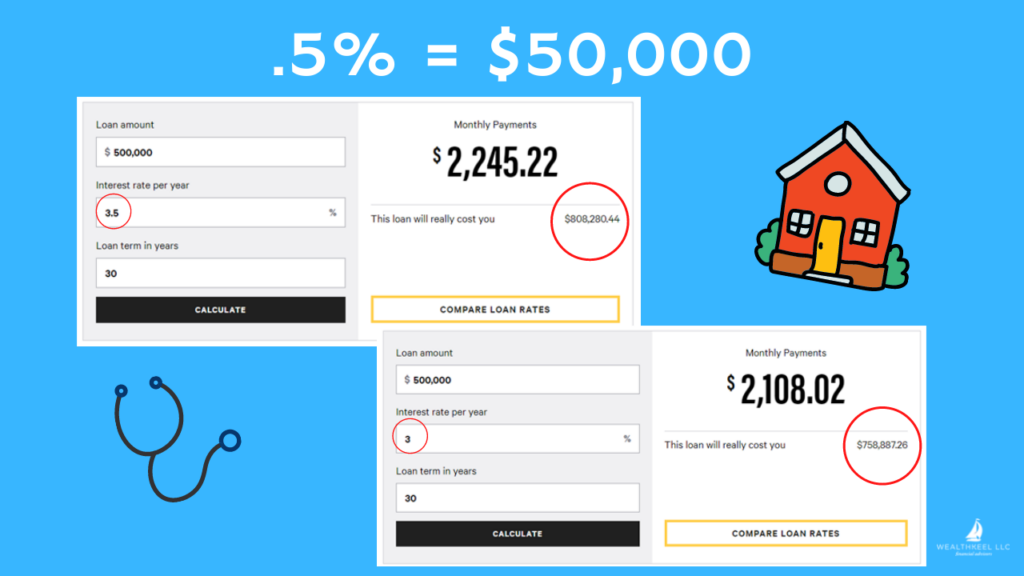
Fixed physician mortgage rates currently run about 0.125% to 0.50% above comparable conventional rates, a narrower gap than the 0.25% to 0.75% premium common in past years. Even a small gap matters at this loan size. A 0.25% difference on a $500,000, 30-year loan adds up to real money over the life of the loan, so compare full APRs, not just headline rates, before you decide.
Limits on Property Types
Some lenders restrict which properties qualify. Condos come with added scrutiny, and investment properties, rental units, and vacation homes are often excluded outright.
Lenders price these loans around their own risk, and properties that are harder to resell carry more of it. Always confirm a property’s eligibility with your lender before you make an offer.
How to Mitigate Risks
- Ask about fixed rates or rate caps, especially if you plan to stay in the home long-term.
- Plan for a refinance window, often 12 to 24 months out, once your income and equity improve.
- Shop multiple lenders and compare pricing, PMI waivers, and property restrictions side by side.
- Run the full numbers, including taxes, insurance, and HOA dues, not just principal and interest.
A physician loan lowers the barriers to buying, but rate risk and property restrictions remain. If stability matters most, a fixed-rate conventional loan or a clear refinance plan may be the better path. Ask a professional to model both scenarios before you decide.
Who Qualifies for a Physician Mortgage Loan?
Eligibility rules vary by lender, but most programs target these roles:
- Medical resident. An offer or appointment letter is often enough, so you can qualify before attending pay begins.
- Fellow or attending. Current income documentation applies, and some pricing tiers factor in 7 to 10 years since finishing training.
- Dentist or veterinarian. Many lenders extend the same programs to these professions.
You’ll also typically need:
- Proof of your degree or diploma.
- A signed contract or offer letter showing start date and salary.
- Strong credit, generally 700 or above, though a lower score is possible with other factors in your favor.
- Student loan documentation, including your IDR statement.
- A post-IDR DTI around 45% or lower.
Documents to have ready: degree or license, contract, pay stubs, bank statements, loan statements, and ID. If you fall short in one area, paying down debt, improving credit, saving toward a down payment, or working with a broker who specializes in physician loans can help close the gap.
What are the Monthly Costs of a Physician Mortgage?
Your total payment breaks down into a few parts, and understanding each one makes it easier to compare loans and budget accurately.
- Principal
- Interest
- Escrow (taxes and insurance)
- HOA, where applicable
Principal reduces your loan balance. Early payments go mostly toward interest, so extra principal payments made now cut the most interest over the life of the loan.
Interest is a percentage of your remaining balance, depending on your rate and loan product. A small rate difference compounds into a large dollar difference, so run your own numbers with a calculator rather than relying on rough estimates.
Taxes and insurance get escrowed into your monthly payment and vary by location. Both tend to rise over time, so budget for some growth rather than assuming today’s numbers hold for 30 years.
HOA dues, where they apply, add an expense separate from your mortgage payment. Factor in utilities, maintenance, and any special assessments.
For a concrete example, a $700,000, 30-year fixed loan shows how these pieces split out. Use a calculator with current rates and your actual escrow and HOA figures for the most accurate picture.
Is a Physician Mortgage Loan Right For You?
These loans remove real barriers to buying, but buying isn’t always the better move. Compare the trade-offs, your timeline, and the alternative of renting before deciding.
When Buying Makes Sense
- You plan to stay 3 or more years, long enough to recover the costs of buying versus renting.
- You have a stable offer or signed contract, which strengthens your underwriting and lowers refinance risk later.
- You need to lock in housing now, whether due to a tight market or a family need.
- Your IDR payment keeps your DTI manageable, letting you take a larger loan without a large down payment.
When Renting Wins
- Your timeline is short,t and you expect to relocate soon, so flexibility matters more than equity.
- You’d rather direct cash toward debt payoff, an emergency fund, or retirement savings.
- You’d prefer a predictable rate and want to build credit or savings before taking on a mortgage.
Quick checklist:
- Staying 3+ years with a stable offer points toward buying.
- Relocating soon or working with unstable cash flow points toward renting while you build credit and savings.
Common Questions About Physician Mortgages
A physician mortgage loan is a home loan designed for medical professionals that often allows a low or no down payment, skips private mortgage insurance, and uses flexible underwriting for student loan debt. Physicians, dentists, residents, and fellows are the most common borrowers.
Eligibility typically includes physicians (MD or DO), dentists, and sometimes other high-income medical professionals. Many lenders also qualify residents and fellows with limited employment history, though the exact requirements vary by lender.
Most physician mortgage loans skip PMI, even with little or no down payment. That lowers your monthly payment compared to a conventional loan, though the tradeoff is a slightly higher interest rate, currently about 0.125% to 0.50% above conventional pricing.
Many lenders count your income-based repayment amount instead of your full loan balance when calculating DTI. That makes it easier for physicians carrying high student loan balances to qualify.
Physician mortgage loans can help you buy a home earlier in your career, but they aren’t automatically the best choice for everyone. Weigh the current interest rate, your long-term plans, and your broader financial goals before choosing this loan type over a conventional one.
📞 Schedule Your Free Icebreaker Call🩺
Ready for a financial plan as straightforward as the care you give your patients? Let’s talk.